Bangkok police logged 16 confirmed fake police shakedowns in the 2024-2025 crackdown window with roughly 11 million baht ($320,000 USD) in cash stolen across the cases. The Bangkok Post bust of an eight-vehicle jet ski gang in Patong landed in the same news cycle. Both numbers travel under the radar of most English tourist guides, which list Bangkok scams without naming the financial exposure per operation or the step-by-step pipeline each one follows.
This guide reads the live picture across Bangkok police statements, the Royal Thai Tourist Police bulletin, the US State Department travel notes, and four foreign-language sources (German, French, Japanese, Korean) that name visual identifiers absent from English coverage. Each scam below carries the pipeline, the red flag, the cash range, and the move that breaks the operation.
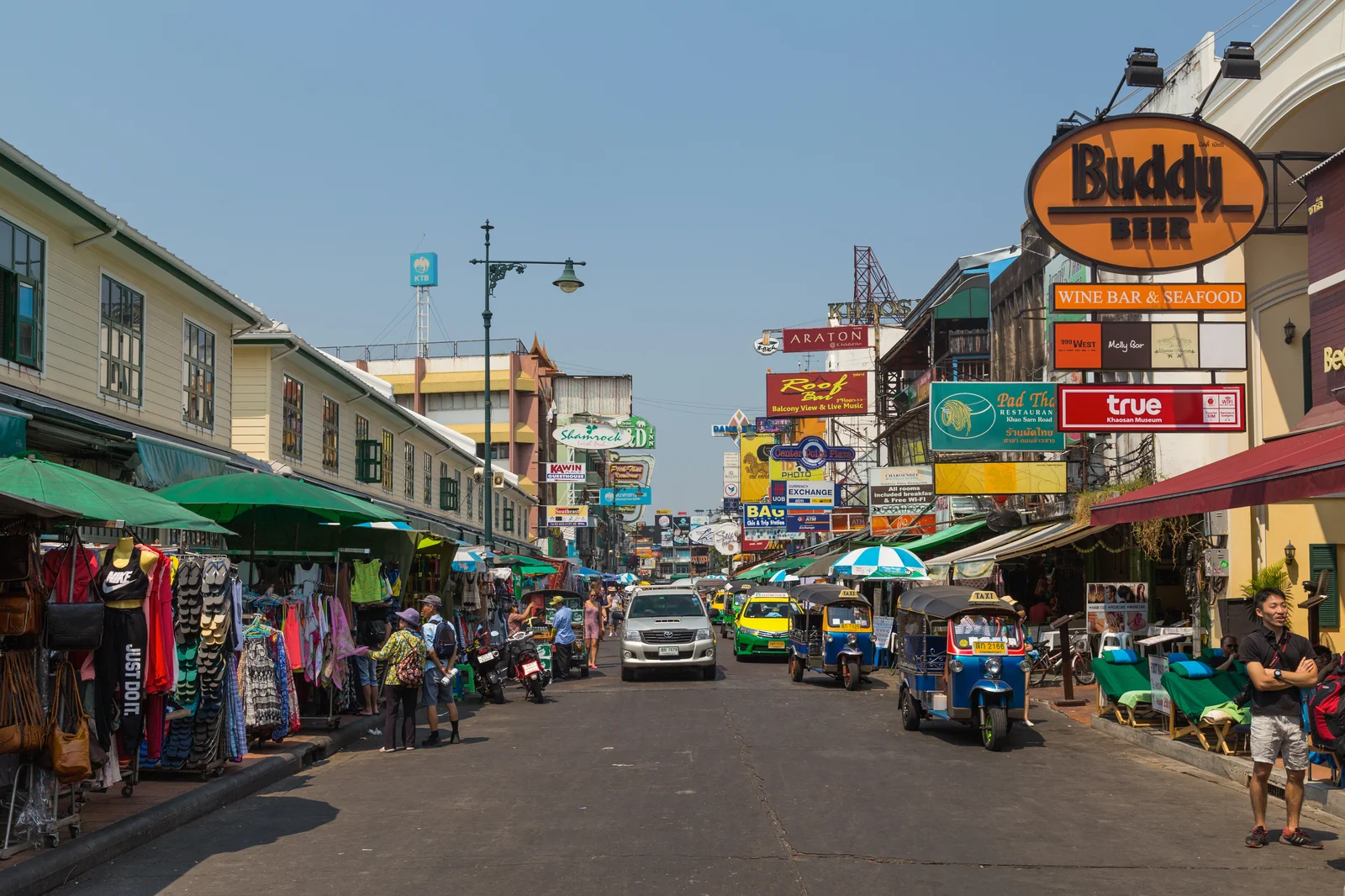 Photographer: Marcin Konsek. Source: Wikimedia Commons. License: CC BY-SA 4.0.
Bangkok scams, the live picture in 2026
The 60-day visa exemption opened to roughly 93 nationalities in July 2024. Tourist arrivals through Suvarnabhumi (BKK) and Don Mueang (DMK) climbed back above 2019 levels in 2025. The scam infrastructure that feeds on that flow is unchanged in operation, but the volume of marks has roughly doubled.
Most operations cluster in five zones. The Grand Palace and Wat Pho corridor. Khao San Road. Sukhumvit between Asok and Nana. The airport arrivals concourses. The BTS exits at major tourist stations. Outside those zones the risk profile drops sharply.
Grand Palace gem scam, the most expensive pipeline
This is one pipeline, not two scams. The English guides separate “Grand Palace closed today” from “gem scam” and miss the operational link. The pipeline runs five stages and is the most expensive single scam in the city.
- Stage 1. A stranger in plainclothes (sometimes in a yellow polo) near Wat Phra Kaew tells you the palace is closed for a royal ceremony.
- Stage 2. A tuk-tuk arrives within 60 seconds offering a 20-40 baht ($0.60-$1.20 USD) “free city tour” while the palace reopens.
- Stage 3. The tour ends at a “government-endorsed” gem export store.
- Stage 4. A Western customer (a paid plant) talks loudly about the great deal they just got. This is the mechanic English guides almost never name.
- Stage 5. Pressure to buy glass stones at 20,000 to 100,000 baht ($600 to $2,900 USD). The stones ship home so you cannot appraise them before departure.
Red flag. Any stranger who volunteers that a major temple is closed today and immediately produces transport. The Grand Palace has near-zero unscheduled closure days. If it is genuinely closed, the official Tourism Authority of Thailand site lists the dates weeks ahead.
The defense move is binary. If anyone near the Grand Palace tells you the palace is closed, ignore them, keep walking to the official entrance on Na Phra Lan Road, and read the gate signage yourself. Free sarong coverings are provided inside the gate at no cost. The stones from the gem store appraise near zero on return and the consent purchase makes legal recovery from abroad close to impossible.
The yellow-flag tuk-tuk and 10-minute commission timer
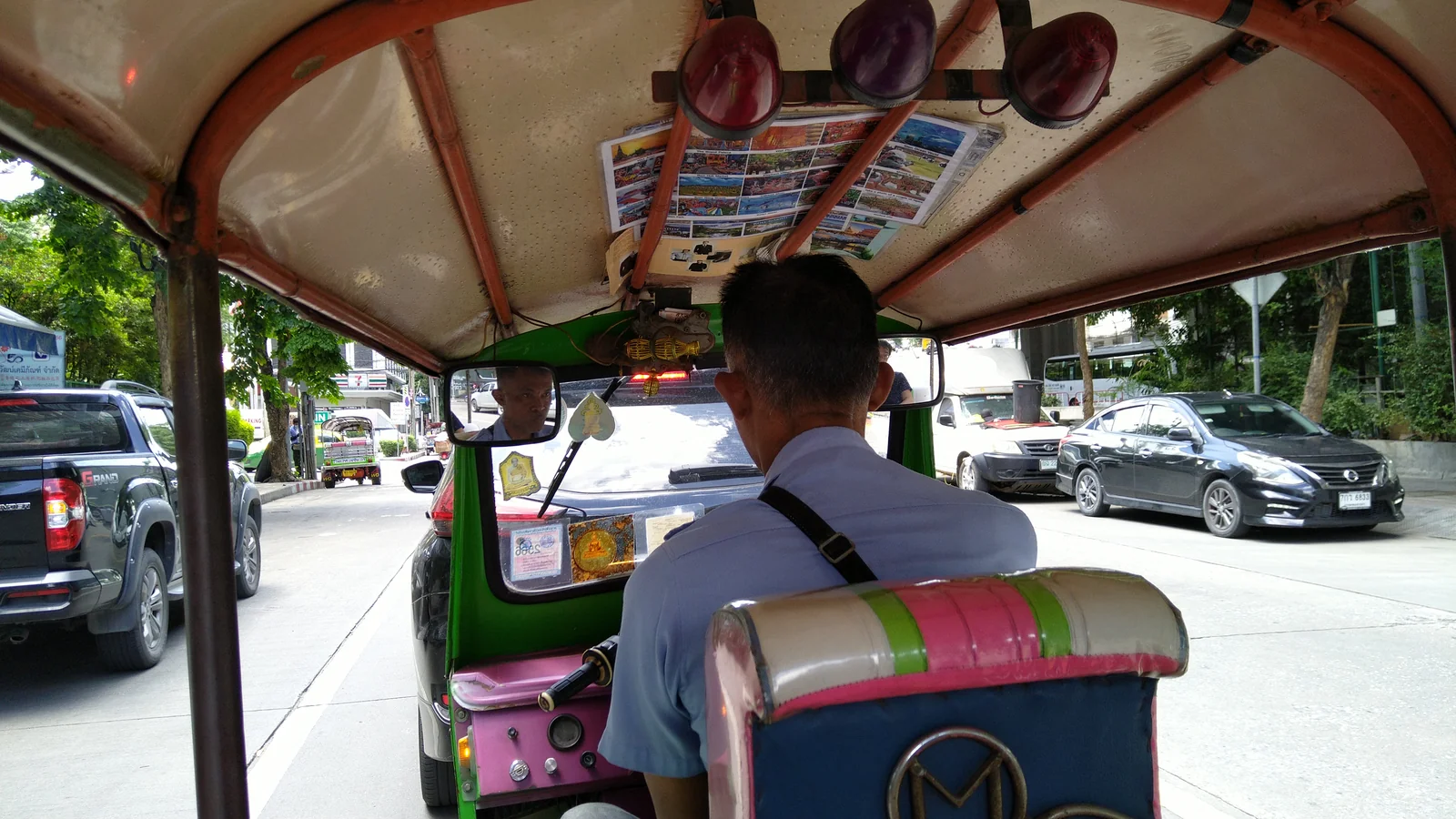 Photographer: Jonashtand. Source: Wikimedia Commons. License: CC BY-SA 4.0.
A German source names the operational detail English guides miss. Drivers earn fuel vouchers and commissions only after the mark spends 10 minutes inside the partner shop. The driver stalls until the timer triggers. A French source adds the visual identifier. The yellow flag on the vehicle marks the commission fleet.
An unsolicited city tour offer at a tourist attraction is not a deal. It is the commission run. A tuk-tuk that quotes 40 baht for four stops is paying for itself a different way.
The going point to point tuk-tuk rates we use for sanity check:
- Grand Palace to Wat Pho (1.2 km): 60-100 baht ($2-$3 USD) one way
- Khao San to Chinatown (3 km): 100-150 baht ($3-$4 USD) one way
- Sukhumvit Asok to Nana (1 km): 60-80 baht ($2 USD) one way
Red flag. Yellow flag on the vehicle plus a multi-stop tour offer plus an unsolicited approach. Any one of the three is enough to walk away.
Ping pong show menus with no venue name
The Patpong and Soi Cowboy version of this scam is mechanical. A tout hands you a printed paper menu listing 100 baht ($3 USD) entry. Inside the venue, drinks you did not order appear at the table. Security blocks the exit when the inflated bill arrives.
How the tab inflates after the printed entry:
- Each 2-minute act demands a 100 baht ($3 USD) tip
- Unordered drinks added at the table: 200-400 baht ($6-$12 USD) each
- Per-person total for 30 minutes inside: 2,000-8,000 baht ($60-$240 USD)
The tell is on the menu itself. A legitimate venue prints its name. The scam menu has no venue name and no fixed address, only a list of acts with prices. A French source documents the same pattern and notes that the printed menu is the only signal needed to walk away.
Taxi meter refusals and the color tell that helps
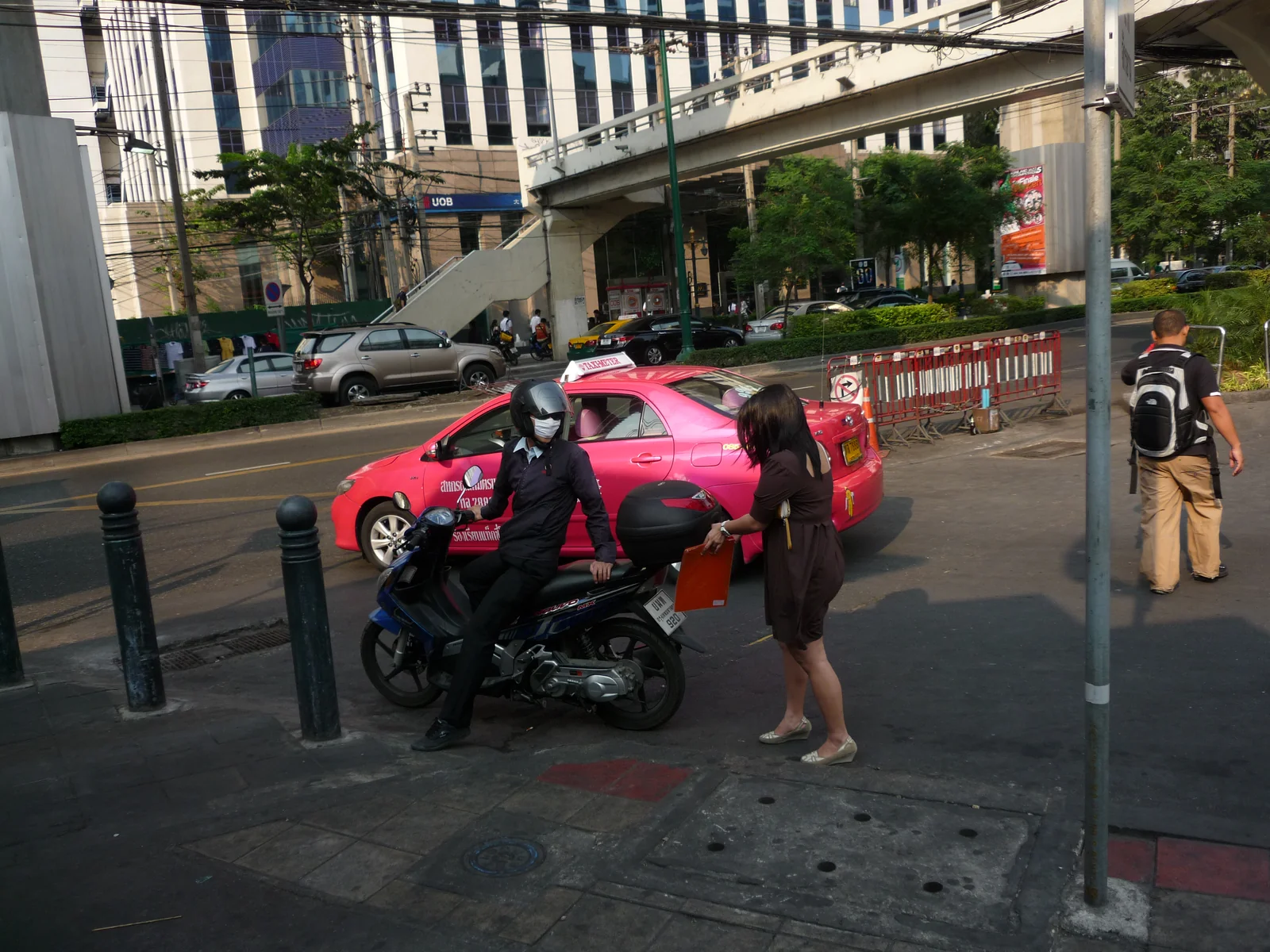 Photographer: ADwarf. Source: Wikimedia Commons. License: Public domain.
The driver who quotes a price before you sit down is the operation. The fare math for the standard arrival:
- BKK to central Bangkok on the meter: 250-400 baht ($7-$12 USD)
- Airport surcharge added at counter: 50 baht ($1.50 USD)
- Expressway tolls if used: 70 baht ($2 USD)
- Unmetered flat quote at the same airport: 600-1,500 baht ($18-$45 USD)
The color tell is subtle but useful. Two-tone green and yellow taxis are owner-operated. Single-color company cabs (orange, blue, yellow, pink) are leased per shift. Owner-operated drivers run the meter more often because the meter income belongs to them. The leased drivers chase flat fares to clear the day rate.
If a driver refuses the meter, get out and take the next cab. The official taxi queue at BKK is past the ground-floor exit clearly marked Public Taxi. Anyone soliciting inside the arrivals hall before that stand is the airport tout, not the queue.
The Suvarnabhumi airport tout queue versus the public taxi stand
The airport tout is a specific role. Unlicensed operators intercept arrivals inside the Suvarnabhumi arrivals hall before the official public taxi queue. They offer a faster ride. The ride is unmetered and uninsured, and the markup runs 2-3x the metered fare with tolls (roughly 600-1,500 baht versus 300-450 baht).
The airport rail link is the safer arrival path if you have under two pieces of luggage. The arrival paths we compare every trip:
- BKK Airport Rail Link to Phaya Thai (26 minutes): 45 baht ($1.30 USD)
- DMK A1 bus to Mo Chit BTS: 30 baht ($0.90 USD)
- DMK metered taxi to central Sukhumvit: 250-350 baht ($7-$10 USD)
Or skip the cab roulette entirely and pre-book a fixed-fare airport transfer through a vetted operator. The receipt and the driver are matched to your booking, which removes the curbside negotiation.
Bar-girl uninvited at Nana and Soi Cowboy
Near Nana Plaza, Soi Cowboy, and Patpong, women approach lone male tourists and join the table without invitation. The pattern is the same across venues. She orders drinks that are charged to your tab. Security blocks the exit when the bill arrives. Per-incident exposure runs 3,000 to 15,000 baht ($90 to $450 USD).
The defense is firm. A bar that lets random women run up your tab is not a bar you stay in. Pay the drinks you actually ordered, refuse the rest, and call the Tourist Police hotline (1155) from inside if the bouncer blocks the door. The hotline operates in English 24/7.
ATM card skimming on standalone kiosks
The high-risk machines are the standalone ATMs outside bank branches, concentrated near Khao San Road, Nana, Patpong, and the 24-hour 7-Elevens that operate independent kiosks. Skimming devices on the card slot copy magnetic-stripe data. Pinhole cameras above the keypad capture the PIN.
Thai banks rarely reimburse foreign-card losses from skimmed transactions, especially when the card holder used a non-bank-branch machine. The defense rule. Bank-branch ATMs only (KBank, SCB, Bangkok Bank, Krungsri), and only the machines inside the branch interior during business hours. The card-slot wiggle test takes one second and catches most overlay skimmers.
If the card was used at a restaurant back terminal, freeze the card from the app the same evening and dispute any non-matching charge within 48 hours.
Fake police shakedowns and the 11 million baht crackdown
The Bangkok police 2024-2025 crackdown documented 16 confirmed fake police cases with roughly 11 million baht ($320,000 USD) in cash stolen. The operation runs from plainclothes men flashing metal-look badges who demand to inspect wallets, phones, or backpacks for counterfeit currency or drug residue. Cash disappears from the wallet during the inspection. Cluster zones. Khao San Road, Sukhumvit between Asok and Nana, and the side sois off Silom.
The rule is firm. The Royal Thai Tourist Police wear marked red-and-blue uniforms. They never demand on-street cash inspections. They never search foreign tourists’ wallets without a recorded reason. A plainclothes officer who asks to count your cash on the street is a thief with a badge.
If a plainclothes man stops you and demands a wallet inspection, hand him nothing. Say I will call 1155 right now and dial the Tourist Police hotline from the spot. Real police welcome that call. Impersonators leave inside 10 seconds. The hotline runs in English 24/7 and the operator can verify the officer’s badge against the precinct registry.
Yellow-shirt temple guide and the dress code sarong vendor
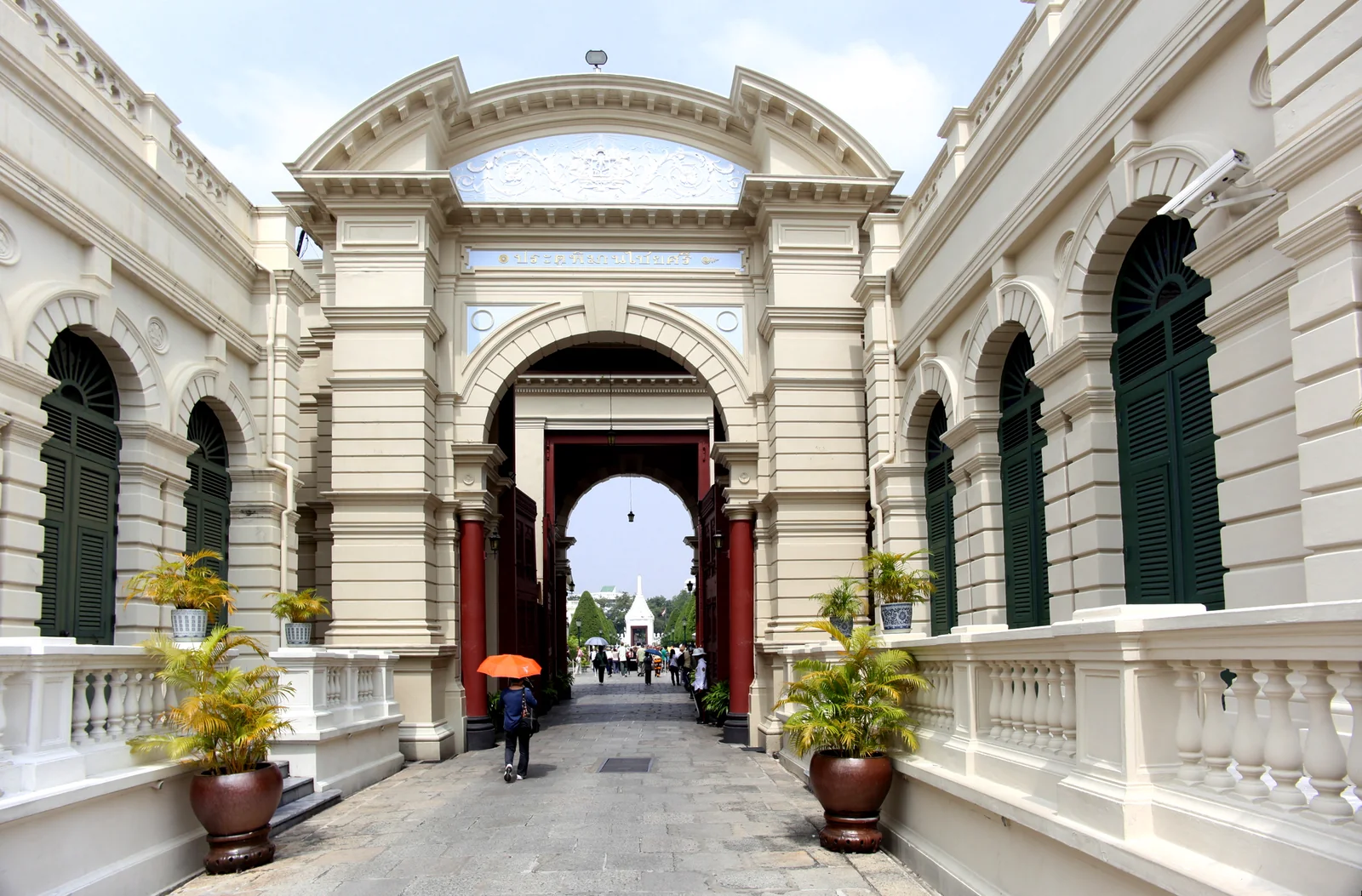 Photographer: Gisling. Source: Wikimedia Commons. License: CC BY-SA 3.0.
Two related operations cluster at the Grand Palace gate. The yellow-shirt temple guide stands outside the entrance and tells you the temple is closed for a royal ceremony or that your clothing violates the dress code. He offers an alternative visit via tuk-tuk, which is stage 1 of the gem pipeline above.
The sarong vendor is the smaller version. He sells you a 300-500 baht ($9-$15 USD) sarong for the dress code. The Grand Palace provides free coverings inside the gate at the dress code checkpoint. The vendor is positioned to intercept before you reach the free service.
Red flag. Any person in yellow or quasi-official dress blocking a temple entrance who is not uniformed Tourist Police. Walk past them to the official gate signage.
Fake TAT tour tables at BTS and train stations
Folding tables with Tourism Authority of Thailand branding appear at major BTS exits, Hua Lamphong railway station, and Ayutthaya train station. The impersonators sell pre-packaged official tours at 5-15x train or public-bus prices. A Japanese source documents the Ayutthaya version specifically. Fake TAT reps sell 2,000 baht ($60 USD) chartered taxi seats for a journey the State Railway of Thailand third-class train covers for 12 baht ($0.40 USD).
Real TAT offices are inside government buildings, never on folding tables, and never sell tours. The official TAT visitor centers in Bangkok sit at the Phra Athit pier and on Ratchadamri Road. Both are clearly signed government premises with marked staff uniforms.
Jet ski damage scam if you continue south
This is the warn-forward entry for travelers who continue from Bangkok to Phuket, Pattaya, or Koh Samui. Operators on Patong, Karon, Kata, and Pattaya beaches point at pre-existing or staged hull damage on return and demand 10,000-50,000 baht ($300-$1,500 USD) for repairs and lost business. Corrupt local police arrive in on the operation.
Bangkok Post confirmed the 8-vehicle Patong gang bust in the 2024 crackdown, which removed the largest concentration of the operation but not its smaller franchises. The defense is the filmed pre-rental walkaround on phone camera, with the operator’s face and voice in the frame agreeing to the visible damage state. Any operator who resists or hides damage from the camera is the operation.
What to do if you get caught in one of these
If you have already paid, the recovery path is narrow but not zero. Call 1155 immediately from the location. Walk to the nearest Tourist Police box (Patpong, Khao San, Sukhumvit Asok, Silom). File the report the same day before you leave the area. Same-day complaints sometimes recover funds when they land at the right precinct, because the precinct can pull the operation’s permit.
For card losses, freeze the card from your bank app inside 60 minutes and dispute the charge under your home bank’s fraud protection. Most Thai-issued cards are uninsured for skimming abroad. Most US, EU, UK, AU, and CA cards reverse skimming charges if the dispute lands within the bank’s window (typically 60-90 days). A pre-trip travel insurance policy with a tourist scam rider raises the recovery ceiling further.
For physical safety, the rule is firm. None of these operations are violent. They depend on time pressure, social embarrassment, and the language gap. Walking away costs zero. The defense move on every scam above is the same. Refuse the urgency. Refuse the cash demand. Dial 1155. Keep moving.
Frequently asked questions
Is Bangkok safe for tourists in 2026?
What is the Bangkok gem scam?
How do I avoid tuk-tuk scams in Bangkok?
Are fake police a real risk in Bangkok?
What should I do if I get scammed in Bangkok?
Is the Grand Palace ever actually closed for ceremonies?
How do I spot a safe Bangkok taxi?
Planning the rest of the trip safely starts with the basics. See our guide on where to stay in Bangkok, and frame the wider route with our Thailand itinerary guide.