Last updated: May 2026
The river is still dark when the monks come out. They move in single file down the lane behind Wat Pho, saffron catching whatever light there is, their bowls held forward with the patience of people who have done this a thousand mornings and expect to do it a thousand more. You are on a plastic stool outside a noodle shop that has no English signage and no prices on the wall, eating something rich and brothy that you ordered by pointing, and you are thinking: I had no idea Bangkok started like this.
That version of Bangkok, the one that finds its way into your memory before the temples do, is available to anyone who arrives without too firm a plan. The city is larger than any itinerary can hold. It runs from royal palaces to contemporary art museums, from pre-dawn markets to midnight river bars, from the silence of a canal neighborhood to the full volume of Yaowarat Road on a Friday night. What follows is not an attempt to compress it. It’s a practical account of twelve things worth doing, organized so that the first day doesn’t feel like a homework assignment.
For hotel recommendations, the best SHA-certified hotels in Bangkok covers where to stay across every price range. And if you’re planning to move on from Bangkok, the ferries in Thailand guide maps the onward connections south.
Temples and Palaces
1. Grand Palace and Wat Phra Kaew (พระบรมมหาราชวัง)
There is a version of the Grand Palace that will disappoint you, and it’s the version where you arrive at 11am in the heat of tourist peak hour and spend forty minutes queuing. Then there is the version where you arrive at 8:30am when the gates open, walk through the outer courtyard into the Emerald Buddha’s hall while the crowds are still forming, and stand for a moment in front of a carved figure that has been the spiritual center of the Thai kingdom for two and a half centuries. That version sits with you differently.
The Emerald Buddha is smaller than visitors expect, seated on a high gilded throne and changed into three seasonal costumes throughout the year by the king himself. The palace complex surrounding it, built from 1782, is worth at least two hours even before you account for the murals in the outer gallery depicting the entire Ramakien epic in 178 panels. Dress appropriately: shoulders and knees covered. Free loaners are available at the gate, so this is a practical note, not a warning.
 PLACE
PLACE
Grand Palace and Wat Phra Kaew (พระบรมมหาราชวัง)
The most visited site in Thailand. The Emerald Buddha inside Wat Phra Kaew is the spiritual center of the kingdom. Arrive at 8:30am opening to beat the crowd that peaks between 10am and 1pm. Shoulders and knees must be covered; free loaners are available at the entrance.
2. Wat Arun (วัดอรุณ)
You notice it first from across the river: the central prang rising to 70 meters, covered in a mosaic of Chinese porcelain fragments that catch the light at angles you don’t expect. This is not an accident. The temple is oriented west, which means it catches the setting sun directly, and coming at dusk turns a very good visit into an excellent one. The cross-river ferry costs less than $1 and runs constantly from the pier near Wat Pho.
The porcelain on the prang is worth looking at closely. Much of it came from Chinese cargo ships that used broken porcelain as ballast. The steep staircases to the upper levels are climbable, though the pitch is genuine, and visitors with mobility concerns should note this before committing to the climb. The view from the second terrace over the Chao Phraya at last light is the version of Bangkok that people describe when they come back.
PLACE
Wat Arun (วัดอรุณ)
The Temple of Dawn, best visited at dusk when the porcelain mosaic prang catches low river light. Take the less than $1 cross-river ferry from the pier near Wat Pho. The upper staircase is steep: not suitable for visitors with limited mobility.
3. Wat Pho (วัดโพธิ์)
The reclining Buddha is 46 meters long and this number doesn’t register until you are standing at its feet, which are themselves taller than you are, inlaid with 108 mother-of-pearl panels depicting auspicious characteristics. The scale is deliberately disorienting. That is the point.
Wat Pho is also where traditional Thai massage was codified as a formal discipline, and you can book a thirty-minute session on-site for $12. The massage school here predates every spa in Bangkok. If you’re going to do a Thai massage in Bangkok, doing it where it was systematized carries a different weight than booking one from a hotel concierge. The massage rooms fill up fast on weekday mornings, so either book ahead or arrive by 9am.
PLACE
Wat Pho (วัดโพธิ์)
Home of the 46-meter reclining Buddha and the birthplace of traditional Thai massage as a formal discipline. On-site 30-minute massage sessions cost $12. Massage rooms book up fast on weekday mornings: arrive by 9am or book ahead.
River and Markets
4. Chao Phraya River (แม่น้ำเจ้าพระยา)
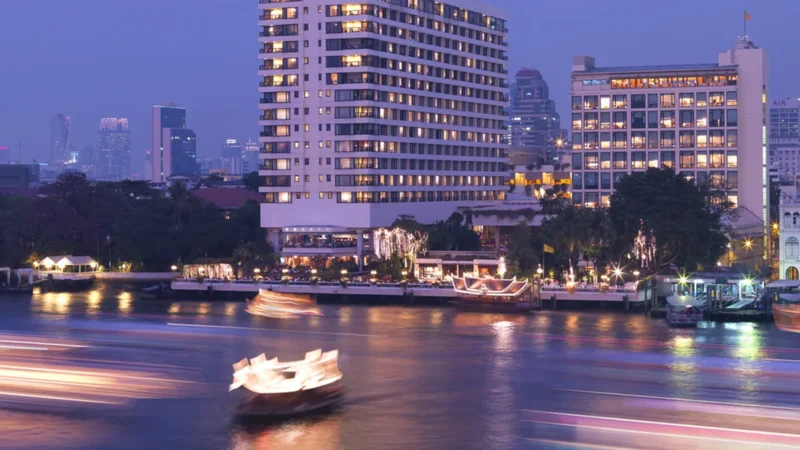
Bangkok was built facing the river. Every royal palace, every major temple, every trading house of consequence was oriented toward the Chao Phraya because this was, for centuries, the only reliable road. The city has grown away from the river in the decades since, but the water still holds a different version of Bangkok, one where the skyline is viewed from a low angle and the scale of the whole thing lands differently.
Evening dinner cruises run between $14 and $43 depending on the operator, and the quality gap between them is significant. Research the specific boat rather than booking on price alone. The alternative, and one that the city itself uses, is the express boat: less than $1 and covering the same route with the same views and considerably less ceremony. Getting on the express boat at Saphan Taksin at dusk, watching Wat Arun pass on the opposite bank, costs almost nothing and is one of the better things you can do in Bangkok on any budget.
PLACE
Chao Phraya River Cruise (แม่น้ำเจ้าพระยา)
Evening dinner cruises include food and views of the illuminated riverfront. Budget option: the BRT express boat (less than $1) covers the same route. Dinner cruise quality varies sharply: research the specific operator before booking, not just the price point.
5. Chatuchak Weekend Market (ตลาดจตุจักร)
Fifteen thousand stalls. Thirty-five sections. Antiques in one lane, live orchids in the next, then vintage denim, then someone selling handmade rattan furniture, then ceramic dogs, then a woman frying khanom krok on a cast iron pan. Chatuchak is not curated. It is the genuine accumulation of everything Bangkok wants to sell on a weekend, and the scale of it is, the first time, genuinely disorienting.
It’s also exhausting if you go without a strategy. The serious visitors set a time limit or pick specific sections in advance. Section 7 for antiques and collectibles. Section 26 for plants and gardening. Sections 2-4 for clothing and vintage. Go with a loose plan and expect to deviate from it. Take BTS to Mo Chit or MRT to Chatuchak Park. Saturday and Sunday, 9am to 6pm.
PLACE
Chatuchak Weekend Market (ตลาดจตุจักร)
One of the largest weekend markets in the world: 15,000 stalls across 35 sections covering antiques, plants, vintage clothing, ceramics, and street food. BTS Mo Chit or MRT Chatuchak Park. The scale is real: go with specific sections in mind or a firm time limit, or both.
6. Or Tor Kor Market (ตลาด อ.ต.ก.)
Or Tor Kor is not a tourist market. It is where Bangkok’s serious cooks and hotel chefs buy their produce, which is why the mangosteen here is stacked by grade, the nam dok mai mangoes have their own dedicated display, and the dried goods section includes things you won’t find labeled in any language you recognize. That’s the point of going.
It’s a ten-minute walk from Chatuchak, open daily, and the small cooked food section at the back serves regional dishes from across Thailand with a level of quality that reflects its clientele. There is no performance here. What you see is what Bangkok actually eats.
PLACE
Or Tor Kor Market (ตลาด อ.ต.ก.)
Premium fresh market next to Chatuchak where Bangkok's serious cooks shop. The best place in the city to see quality Thai produce: mangosteens graded by quality, nam dok mai mangoes, jackfruit, durian. Small cooked food section serves regional dishes. No English signage: that's precisely why it's worth going.
Cultural Experiences
7. Jim Thompson House (บ้านจิมทอมป์สัน)
Jim Thompson was an American who arrived in Bangkok after World War II, revitalized the Thai silk industry, and then disappeared in the Malaysian highlands in 1967 without explanation, never to be found. His house is what he left behind, and it is a more interesting object than that summary suggests.
He assembled six traditional Thai houses into a single compound in Pathumwan, filling them with Cambodian sculptures, Chinese porcelain, and antique Thai objects that he collected with the eye of someone who understood what he was looking at. The guided tours in English run hourly and cover the architecture, the collection, and the mystery. There’s no self-guided option inside the main houses, which is not a limitation: the guide is actually the point.
PLACE
Jim Thompson House (บ้านจิมทอมป์สัน)
A compound of six traditional Thai houses built by the American silk trader who disappeared in 1967. The best Bangkok museum for understanding traditional Thai domestic architecture and decorative arts. English-language guided tours run hourly. No self-guided option inside the main houses.
8. Lumphini Park (สวนลุมพินี)
At 6am on a weekday, Lumphini Park is doing something that has nothing to do with tourism. Groups of older Thai men and women are moving through tai chi forms near the lake. A sound system somewhere is playing aerobics music that hasn’t been updated since the 1990s. People are walking with the purposeful rhythm of people who have done this every morning for years. The park is 142 acres in the middle of Silom and it runs its own quiet rhythm entirely separate from the city around it.
The monitor lizards are real. They can reach two meters and they move through the grass near the lake with complete indifference to the humans around them. You notice this later: you walked past a two-meter reptile and it did not seem remarkable at the time. By evening the park belongs to joggers and couples. Come in the morning.
PLACE
Lumphini Park (สวนลุมพินี)
142 acres of parkland in the middle of Silom, home to morning tai chi groups, aerobics classes, joggers, and genuinely large monitor lizards near the lake. Best in the early morning when local activity is at its peak. Midday in hot season (March-May) is genuinely unpleasant.
9. Chinatown / Yaowarat (ไชน่าทาวน์) Night Food Scene
Yaowarat Road at 8pm is a particular kind of sensory experience that resists description but rewards showing up. The gold shops that line the street are still lit, their windows dense with 96.5% gold jewelry that Bangkok’s Chinese community has been buying here for a hundred and fifty years. Between them, the street food vendors have set up their carts, and the smoke from the charcoal grills has reached a point where it softens everything into orange.
The food itself: pad see ew from a cart with a queue, roast duck over rice from a shophouse with its ducks hanging in the window, hoy tod (oyster omelette) from whoever has the most blackened pan. Don’t navigate by map. Walk toward the smoke and the crowds, then follow that logic from one stall to the next. The Talat Noi neighborhood just behind Yaowarat is quieter, older, and worth walking through before the food.
PLACE
Chinatown and Yaowarat Night Food (ไชน่าทาวน์)
Bangkok's Chinatown comes alive after 6pm when street food carts set up along Yaowarat Road. Gold shops, dried seafood merchants, roast duck shophouses, and charcoal-grilled seafood. Walk toward the smoke: navigating by map misses the logic of how it's laid out.
Contemporary Bangkok
10. MOCA Bangkok (Museum of Contemporary Art)
MOCA is far enough from central Bangkok that most visitors skip it, which is one reason to go. The building is a deliberate object: six floors of a structure that curves and juts in ways that Thai contemporary architecture rarely attempts, built to house a private collection of over 800 works spanning Thai modernism to the present.
The collection prioritizes Thai artists who would not appear in any international survey, and spending two hours here gives you a sense of what Thai contemporary art looks like when it’s not being curated for an export audience. The museum is in Ngam Wong Wan, accessible only by taxi or private car. That trip is worth planning around.
PLACE
MOCA Bangkok (Museum of Contemporary Art)
Private collection of 800+ Thai contemporary artworks across six floors in an architecturally distinctive building in Ngam Wong Wan. The best museum in Bangkok for understanding Thai modern art. Accessible by taxi or private car only: no BTS or MRT access.
11. Asiatique The Riverfront (เอเชียทีค)
Asiatique occupies the former docks of the Danish East Asiatic Company, and the colonial warehouse bones are still there under the retail operation that now fills them. There’s something interesting in the gap between what the buildings were and what they are now. The Chao Phraya in the background at night, the Ferris wheel against the sky, the Muay Thai Live show in one of the converted warehouses: it’s a lot of Bangkok’s appeal compressed into one location.
It is also largely a tourist mall, and worth naming as such. One evening here is interesting. A second evening would require a specific reason. The free shuttle boat runs from Saphan Taksin BTS every thirty minutes from 4pm and this is how you should arrive, not by taxi.
PLACE
Asiatique The Riverfront (เอเชียทีค)
Riverside shopping and entertainment in converted colonial warehouses. Ferris wheel, Muay Thai Live show, 1,500 boutiques and restaurants. Free shuttle boat from Saphan Taksin BTS every 30 minutes from 4pm: use the boat, not a taxi. Worth one evening, not two.
12. Khlong Lat Mayom Floating Market (Day Trip)
The floating market as tourist theater is well established in Bangkok and easy to find. Khlong Lat Mayom is what it looks like before the theater sets in. On most weekends, locals outnumber tourists, the vendors are selling to their neighbors, and the food being cooked on the boats is the food the neighborhood actually eats, not a performance of what tourists expect Thai food to look like.
There is no English signage and this is part of the information. Thirty minutes by taxi from Silom, open Saturday and Sunday from 9am to 5pm, free entry. Go without a plan, point at things that are cooking, and pay what’s asked. The absence of the tourist infrastructure is the experience.
PLACE
Khlong Lat Mayom Floating Market
The least tourist-oriented floating market near Bangkok: locals outnumber visitors most weekends, there's no English signage, and the food is what the neighborhood eats. 30 minutes by taxi from Silom. Saturday and Sunday only, 9am-5pm. No English signage is both the limitation and the reason to go.
Getting Around Bangkok
Bangkok’s BTS Skytrain and MRT cover the modern city efficiently. For the old city around the temples, tuk-tuks and river ferries are the right tools. Traffic between Sukhumvit and Rattanakosin at peak hours can turn a 3km taxi ride into forty minutes, so defaulting to BTS for anything the network reaches is not just faster, it’s also cheaper. The river express boat (less than $1) is the most efficient way to move between the temple district and the shopping districts further south.
If you’re heading south toward the islands after Bangkok, the ferries in Thailand guide covers all the main routes and operators, including the Bangkok to Koh Samui bus and ferry connection and onward to SHA-certified hotels in Koh Samui. For those going north, the Chiang Mai hotel guide covers the city well.
Book Transport in Bangkok
Compare trains, buses, and ferry connections from Bangkok.
Where to Stay in Bangkok
Your hotel’s location shapes the version of Bangkok you spend your days in. The temple district gives you early mornings; Sukhumvit gives you the BTS and the restaurant density; the riverside gives you the Chao Phraya at all hours. The full list of SHA-certified hotels in Bangkok covers all three zones. Three worth noting here, across price ranges:
STAY
Sala Rattanakosin
A boutique riverside hotel with direct sight lines to Wat Arun from the rooftop bar, walking distance to Wat Pho and the Grand Palace. Agoda score 9.0. The location is the product: you're in the old city, which means early mornings look different. The limitation is scale: it's small, books early, and lacks the amenity range of the larger riverside properties.
STAY
Mandarin Oriental Bangkok
Opened in 1876, the Mandarin Oriental is the hotel that defines what Bangkok luxury looks like in the Western imagination, and it's earned that. Agoda score 9.2. The Authors' Wing has housed Noel Coward, Somerset Maugham, and Joseph Conrad. The afternoon tea in the Authors' Lounge is worth doing once regardless of where you're staying. For Asiatique access, the hotel's own river shuttle is the right way to arrive. Rates reflect the address.
STAY
Novotel Bangkok Sukhumvit 4
Mid-range reliability in the right location. BTS Asok puts you one stop from Terminal 21, direct access to the Sukhumvit restaurant corridor, and a straightforward connection to the airport on the same line. Agoda score 8.7. The hotel doesn't have the character of the riverside properties but the operational efficiency of a location like this earns its place in the Bangkok lineup. Good choice for people who want BTS access to everything without paying luxury rates.
Planning beyond Bangkok? The best SHA hotels in Phuket and best SHA hotels in Koh Samui are the next logical stops south.
Frequently Asked Questions
How many days do you need in Bangkok?
Three days covers the essential sites: the Grand Palace district on day one, the river and Chatuchak on day two, Chinatown and a contemporary experience like MOCA or Asiatique on day three. Four or five days lets you move at a slower pace and add a floating market day trip. Bangkok rewards slowing down: the version of the city you find at 6am or on an express boat at dusk is different from the one on the tourist circuit, and it takes a few days before you start to find it.
What is the cheapest way to get around Bangkok?
The BTS Skytrain and MRT cover most modern Bangkok for less than $1-2 per journey depending on distance. The Chao Phraya Express Boat costs less than $1 and is the fastest way to move through the old city temple district. Tuk-tuks are more expensive than taxis for most trips and require negotiating a price before you get in. For anything within BTS reach, the train beats traffic and costs a fraction of a taxi in peak hours.
What should I not miss in Bangkok?
The Grand Palace and Wat Phra Kaew at 8:30am opening hour, before the crowds. Wat Arun at dusk from across the river, even if you don’t cross. Yaowarat Road in Chinatown after 6pm when the street food sets up properly. And at least one morning in Lumphini Park or on the express boat: the city has a quieter character in those early hours that the rest of the itinerary won’t show you.
Is Bangkok safe for solo travelers?
Bangkok is one of the more accessible solo travel cities in Asia. The BTS and MRT are safe, well-signed in English, and run until midnight. Scams exist, mostly around tuk-tuk drivers offering unsolicited sightseeing tours that divert to gem shops or suit tailors. The standard practice is to book taxis through Grab rather than flagging from the street, and to be skeptical of anyone who approaches you near the Grand Palace offering a “shortcut” to a nearby attraction that’s supposedly closed. Neither of these is a serious risk if you know to expect them.