The BTS Skytrain in Bangkok runs from 06:00 to midnight, charges 17 to 47 baht (about $0.50 to $1.45 USD) for a single trip, and beats a taxi during the 17:30 to 19:30 rush by a margin that rewrites the entire afternoon. The part that trips people up is where the system stops being one network and becomes three, and which station exit decides whether you walk 90 seconds or 8 minutes in 33 degree heat. Pick a hotel in the wrong area and the Skytrain saves nothing.
We’ve ridden every Sukhumvit Line interchange on weekday peak, mapped exit numbers against the major hotel lobbies, and timed the booth versus machine top up at four stations. This guide pairs the standard fares and hours primer with the local moves: which exit serves your hotel, where the “interchange” isn’t actually one, and when a Rabbit Card costs more than it saves.
How the BTS actually works in 2026
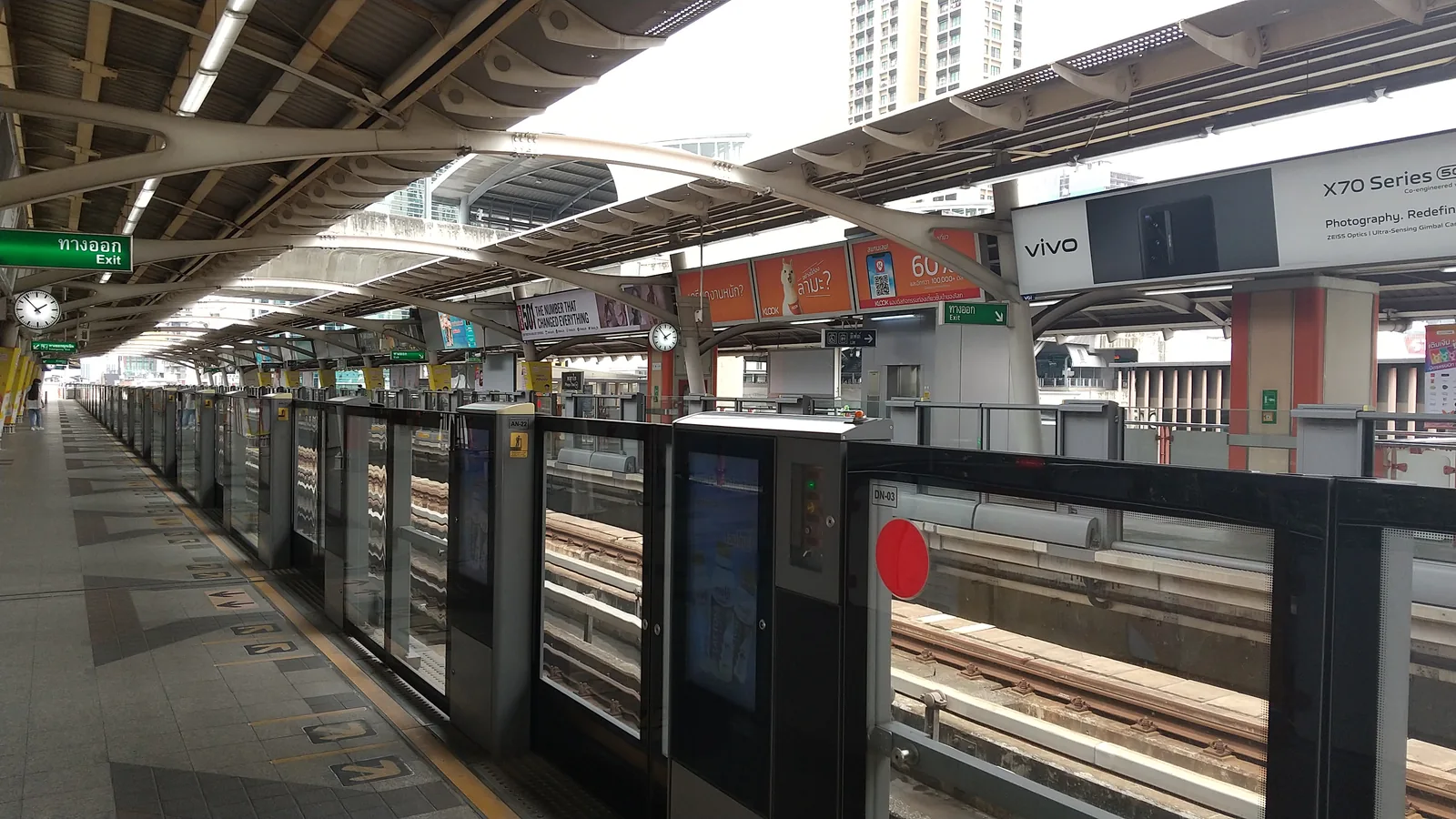 Photographer: Suikotei. Source: Wikimedia Commons. License: CC BY-SA 4.0.
The system is three lines, 64 stations, one operator (Bangkok Mass Transit System PCL). Trains run every 3 to 6 minutes at peak and every 8 minutes off peak. First train 06:00. Last train midnight on both main lines.
- Sukhumvit Line (light green): 47 stations. Runs north to south, Khu Khot at the top to Kheha in the southeast. The core tourist segment is Mo Chit to On Nut, which covers Chatuchak Weekend Market, Siam, Asok, Phrom Phong, and Thong Lor.
- Silom Line (dark green): 14 stations. National Stadium to Bang Wa, crossing the river at Saphan Taksin. Serves Silom CBD, Sala Daeng, Saphan Taksin (the pier for Chao Phraya river boats).
- Gold Line: 3 stations. Automated people mover, flat 16 baht, opened 2020. Runs Krung Thon Buri to Khlong San and links to ICONSIAM mall on the river. You’ll only use it if you’re shopping at ICONSIAM.
The two main lines cross at one station only: Siam. That transfer at Siam is the only place in the BTS system where you change lines on the same platform without exiting and paying a fresh fare. We come back to why that matters in the interchange section.
Paying for the BTS Skytrain in three ways
Three ways to pay. The right choice depends on how many trips you’ll take, not on which one the English guides recommend by default.
Single trip ticket
Touch screen vending machines at every station. You select a destination station on the route map, the machine prints the fare (17 to 47 baht), you feed coins. Two practical issues riders learn the hard way.
- Most ticket machines accept coins only. A few accept 20 and 100 baht notes. Almost none accept 500 or 1,000 baht.
- The ticket booth at every station accepts any denomination. Break a large note at the booth before you walk to the machine.
A 100 baht note plus four twenties gets you through a day of single trips without ever queuing twice.
Rabbit Card
The contactless stored value card. 100 baht (about $3 USD) issuing fee, 100 baht minimum initial top up, valid 5 years. Top up in 100 baht increments up to 4,000 baht stored. Refund is possible at designated counter stations with passport ID, and the operator deducts a 50 baht processing fee.
The break even math the English guides skip. The 100 baht issuing fee plus the 50 baht refund deduction equal 150 baht in sunk cost. At an average 30 baht per trip, the Rabbit Card pays for itself at 5 trips. For a 2 day visitor doing the standard Chatuchak loop plus the Grand Palace plus Asiatique evening, that lands right at break even. For a 1 day stopover doing 3 trips, the single trip ticket is cheaper.
The practical Rabbit Card move locals make. Top up at the ticket booth, not the auto top up machine. The machines reject 1,000 baht notes at most stations. The booth doesn’t.
One Day Pass
140 baht (about $4 USD), unlimited rides on the same calendar day on both Sukhumvit and Silom lines. Worth it if you’re doing 5 or more trips in a single day. Sold at every station counter.
The Rabbit Card does NOT work on the MRT subway. The MRT runs a separate card (now branded “MRT Plus”). Same hand, same wallet, different system. Anglo guides flatten this into “Bangkok metro card” as if one card works everywhere. It doesn’t.
Major BTS stations and which hotels they actually serve
The station name on the system map tells you which area. The exit number tells you whether you arrive at your hotel lobby or 250 meters away on the wrong side of an eight lane road. French and Japanese travel guides treat exit numbers as decision data. Anglo guides skip them. Five stations cover most central Bangkok hotels, and at each one the exit choice matters.
Siam (Sukhumvit + Silom Lines)
The system hub. Same platform transfer between Sukhumvit and Silom Lines. Exits feed Siam Paragon (exit 3, 5), Siam Discovery (exit 1), Siam Square (exit 2, 6), and the Kempinski hotel side gate (exit 6). No major branded hotel sits directly on Siam, but the area is the connector for everything else.
Asok (Sukhumvit Line)
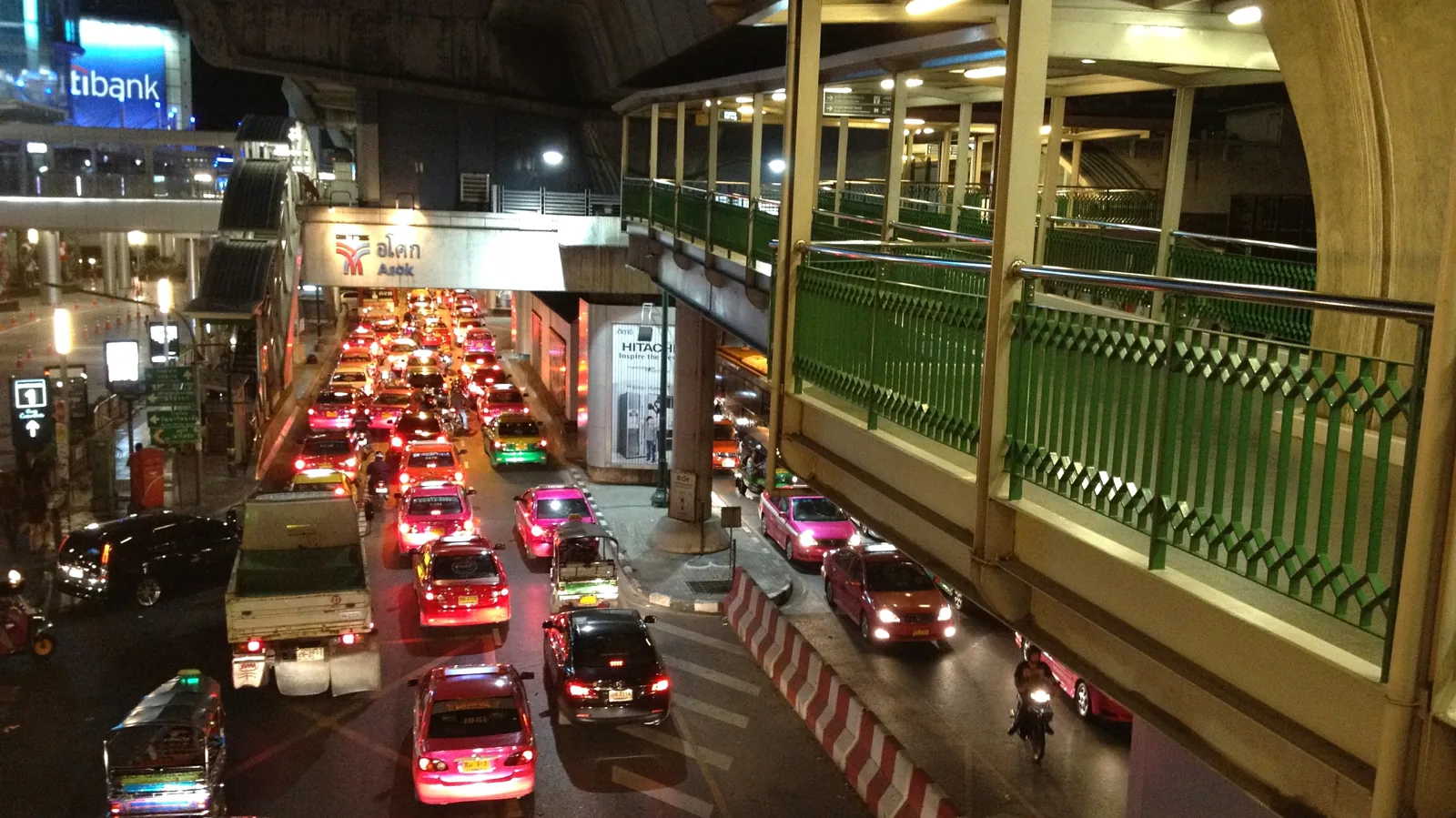
The Sukhumvit interchange. Exit 2 lands you inside Terminal 21 mall, climate controlled, escalator down to the basement food court, covered walkway in the Soi 24 direction toward Hilton Sukhumvit Bangkok. Exit 4 drops you at street level on the south side of Sukhumvit Road, 250 meters from the same destinations in full sun with a road crossing. The 4 minute walk through the mall beats the 8 minute walk on the road. Same station, two completely different arrivals.
Chit Lom (Sukhumvit Line)
The shopping district. Exit 5 to Central Embassy and the Park Hyatt side. Exit 8 to Central Chidlom and the Big C across the road. The Erawan Shrine sits between exits 2 and 4. Most Chit Lom hotel guests want exit 5 for the embassy side or exit 4 for the Ratchaprasong intersection.
Phloen Chit (Sukhumvit Line)
One station east of Chit Lom. Exit 5 to the Conrad Bangkok. Exit 2 connects via skybridge through Park Ventures Building to The Okura Prestige Bangkok. The skybridge keeps you out of the heat for 80% of the walk.
Sala Daeng (Silom Line)
The Silom CBD. Exit 2 to Silom Complex and the Eastin Grand Sathorn direction (which has its own BTS skybridge from Surasak one stop south). Exit 4 to the Dusit Thani Bangkok side. Sala Daeng connects to the MRT Silom station via a 200 meter covered walkway, which we cover in the interchange section.
Saphan Taksin (Silom Line)
The riverside connector. Exit 2 leads to Sathorn Pier, the boarding point for Chao Phraya river boats and for the free hotel shuttle boats to Mandarin Oriental, Peninsula, and Shangri La. A 25 baht Chao Phraya Express Boat from Sathorn Pier reaches Tha Tien (Wat Pho and Grand Palace) in 25 minutes.
Mo Chit (Sukhumvit Line)
The northern terminus of the tourist segment. Exit 1 leads directly to Chatuchak Weekend Market (สวนจตุจักร). Exit 3 connects to the BTS to MRT walkway and the Northern Bus Terminal direction. Weekend mornings, exit 1 turns into a slow shuffle from 09:00 onward.
Where the BTS interchange isn’t actually an interchange
 Photographer: David McKelvey from Brisbane, Australia. Source: Wikimedia Commons. License: CC BY 2.0.
Read the Bangkok system map and the BTS, MRT, and Airport Rail Link look like one integrated metro. They’re not. They’re three networks with covered walkways between them, three separate stored value cards, and three fresh fares per system change. Swiss and German travel desks call this out explicitly. Anglo guides flatten it.
Here’s what the four major interchanges actually cost in time and money.
- Asok (BTS) to Sukhumvit (MRT Blue Line): 250 meter covered walkway. 3 to 4 minutes. Fresh MRT fare (16 to 42 baht). Use this to reach Hua Lamphong, Chinatown (Wat Mangkon), Lumphini Park.
- Sala Daeng (BTS) to Silom (MRT Blue Line): 200 meter covered walkway. 3 minutes. Fresh MRT fare. Reaches Chinatown and the southern Blue Line loop.
- Mo Chit (BTS) to Chatuchak Park (MRT Blue Line): 150 meter covered walkway. 2 to 3 minutes. Fresh MRT fare. Reaches Bang Sue / Krung Thep Aphiwat for SRT long distance trains.
- Phaya Thai (BTS) to Phaya Thai (Airport Rail Link): 100 meters, same building, two escalators. 2 minutes. Fresh ARL fare (45 baht express to BKK).
Budget 5 to 8 extra minutes per system change. Budget another ticket on each. The “Bangkok metro” is faster than a taxi at rush hour, but it’s not a unified network the way the system map implies.
BTS versus MRT versus Airport Rail Link
Three systems, three coverage areas, three networks of stations. The honest comparison from a tourist standpoint.
- BTS Skytrain: serves Sukhumvit (Asok, Phrom Phong, Thong Lor), Silom CBD, riverside (Saphan Taksin), and the Mo Chit and Chatuchak corner. Most international 4 and 5 star hotels sit on the BTS Sukhumvit Line within 200 meters of a station.
- MRT Blue Line: serves Chinatown (Wat Mangkon, Hua Lamphong), Sam Yan, Lumphini Park, the Queen Sirikit convention area, and the northern bus terminals. The Old City (Grand Palace, Wat Pho) is NOT on the MRT. The closest stop is Sanam Chai, which then needs a 10 minute walk.
- Airport Rail Link: connects Phaya Thai (BTS interchange) to Suvarnabhumi (BKK) airport in 26 minutes for 45 baht. Does NOT serve Don Mueang (DMK) airport. DMK requires the SRT Red Line from Bang Sue or a taxi.
For the airport question. If you fly into BKK, the ARL is the cheapest fast option. If you fly into DMK, the cheapest fast option is a taxi for 200 to 300 baht (25 minutes off peak, 60 at rush). The cheapest slow option is BTS to Mo Chit, MRT to Bang Sue, SRT Red Line to DMK. Budget 90 minutes.
When the BTS is NOT your best choice
 Photographer: User:Diliff. Source: Wikimedia Commons. License: CC BY-SA 3.0.
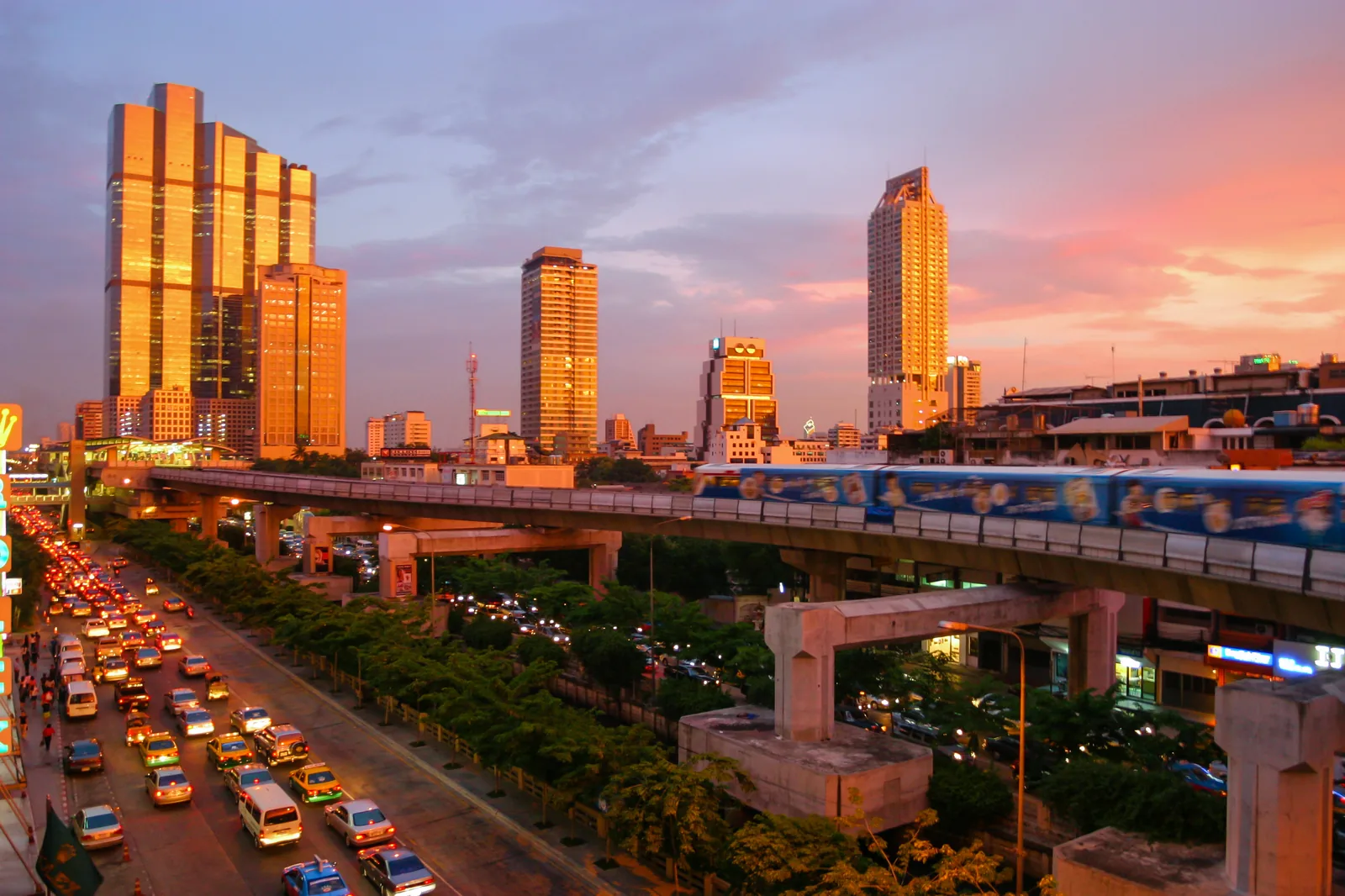
The BTS is faster than a taxi in rush hour by a wide margin. It’s the wrong tool in three situations.
- Late at night. Last train is midnight on both main lines. After 24:00 the only options are Grab, Bolt, or a metered taxi. Grab from Sukhumvit to Khao San typically runs 150 to 250 baht. The savings over BTS evaporate, but you have no other choice.
- To Khao San Road, the Old City, or Chinatown. No BTS station reaches Khao San. The closest BTS stop to the Grand Palace is Saphan Taksin plus a 25 minute river boat. The MRT goes to Wat Mangkon (Chinatown) but the walk from there to Yaowarat night market is 6 to 10 minutes. For these neighborhoods, a Grab or a Chao Phraya Express Boat is faster.
- 17:30 to 19:30 at Asok or Siam, with luggage. Peak rush at the central interchanges hits 8 passengers per square meter. Japanese travel reviewers compare it to Tokyo rush hour, which for a Japanese reviewer is the upper benchmark. With a backpack you survive. With a wheeled suitcase you don’t fit through the turnstile gracefully. Take a taxi.
The Friday 18:00 to 20:00 corridor is the single worst window of the week. Sunday late afternoon at Mo Chit is the second worst, when the Chatuchak Weekend Market crowd heads home all at once.
Where to stay near the busiest BTS interchanges
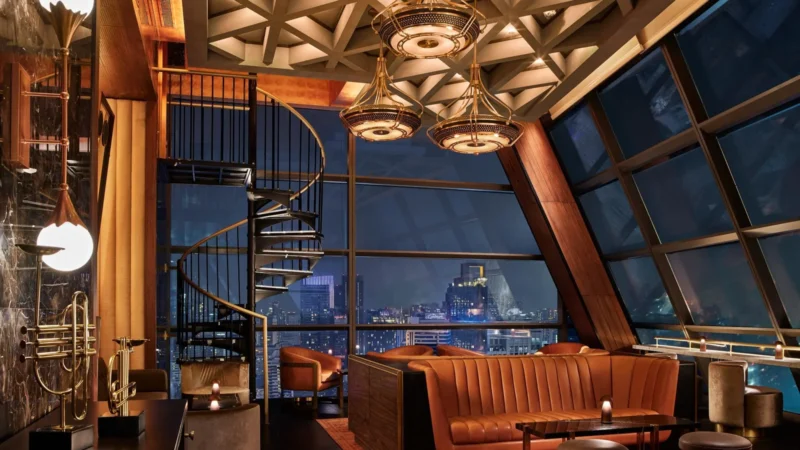
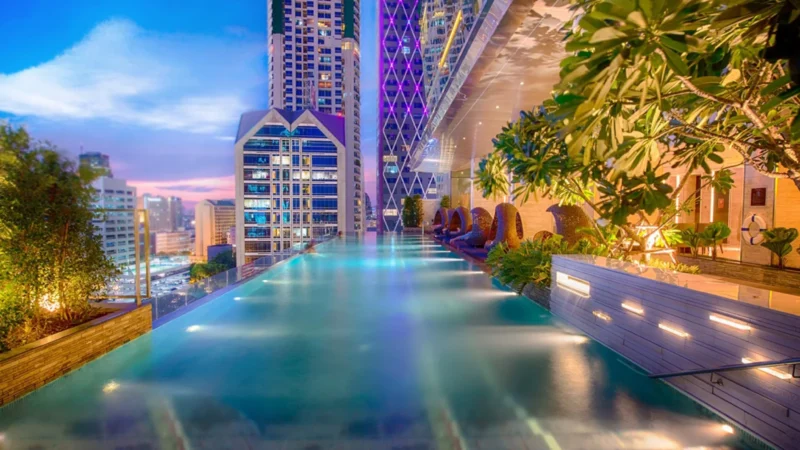
Three Bangkok hotels that put you within 200 meters of a BTS station, each on a different line and a different style of neighborhood. Pick by what your day actually involves.
 SHA Extra Plus
★ 9.2
SHA Extra Plus
★ 9.2
Rosewood Bangkok
 SHA Plus
★ 9.1
SHA Plus
★ 9.1
Eastin Grand Hotel Sathorn
 SHA Certified
★ 8.7
SHA Certified
★ 8.7
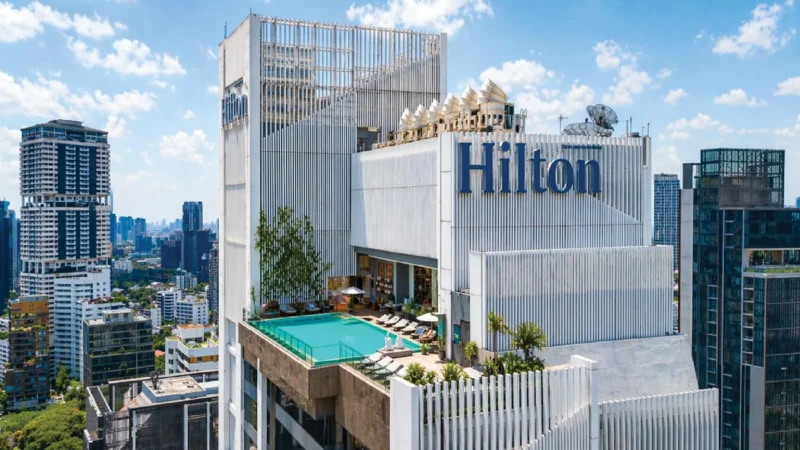
Hilton Sukhumvit Bangkok
For a longer list with rates and area context, our Bangkok hotel roundup covers 10 properties by area and tier. If you’re working a 3 day Bangkok itinerary, the BTS-adjacent hotel saves you 30 to 60 minutes of taxi time per day during peak. That stack of saved minutes is what makes the 3 day Bangkok plan actually fit.
Getting between BTS stations and the rest of Bangkok
The Skytrain handles the central commercial corridor and the Sukhumvit hotel strip. Three categories of attraction need a different plan.
- Food and night markets: most of the central Bangkok options on our restaurant list sit within 5 minutes of a BTS station on the Sukhumvit, Silom, or Saphan Taksin segments. The exceptions are the Yaowarat Chinatown street stalls (use MRT Wat Mangkon) and the Old City riverside spots (use Saphan Taksin plus Chao Phraya Express Boat).
- Rooftop bars: Vertigo at Banyan Tree (Sala Daeng), Sky Bar at Lebua (Saphan Taksin), and Octave at Marriott Sukhumvit (Thong Lor) are all BTS accessible. The rest, including most of our rooftop list, need a Grab.
- Cultural sights and shows: Wat Pho and the Grand Palace are not on the BTS. Use Saphan Taksin BTS plus an express boat. For Muay Thai at Lumpinee or Rajadamnern (both reviewed in our Muay Thai shows roundup), Lumpinee is reachable via MRT Lat Phrao. Rajadamnern needs a Grab. Bangkok nightlife districts Thonglor and Ekkamai both have direct BTS access.
If you’re moving onward from Bangkok to other cities, the Bangkok to Chiang Mai sleeper train departs Krung Thep Aphiwat (Bang Sue), which sits two MRT stops from Mo Chit BTS. Bangkok to Phuket overland is a 12 hour bus or a 90 minute flight from BKK, neither of which the BTS covers.
Frequently asked questions about the BTS
Is a Rabbit Card worth it for a short Bangkok trip?
What time does the last BTS train run?
Can I take the BTS to Suvarnabhumi airport?
Which BTS station is best for the Grand Palace?
Does the Rabbit Card work on the MRT subway?
How crowded does the BTS get at rush hour?
Is the BTS safe at night?
Planning the wider trip around the Skytrain? See our Thailand itinerary guide.