The longtail boat drops you on Railay West, and a short walk across the headland reaches a resort that sits between three beaches at once. Phra Nang lies on one flank, Railay West and Railay East on the others, with no road touching any of it. The limestone karsts wall off the rest of the coast, and the pavilions spread across ground you can reach only by water. It is a less natural fit for travelers who picture nightlife a short walk away, or who want to drift between hotels and beach bars on a whim.
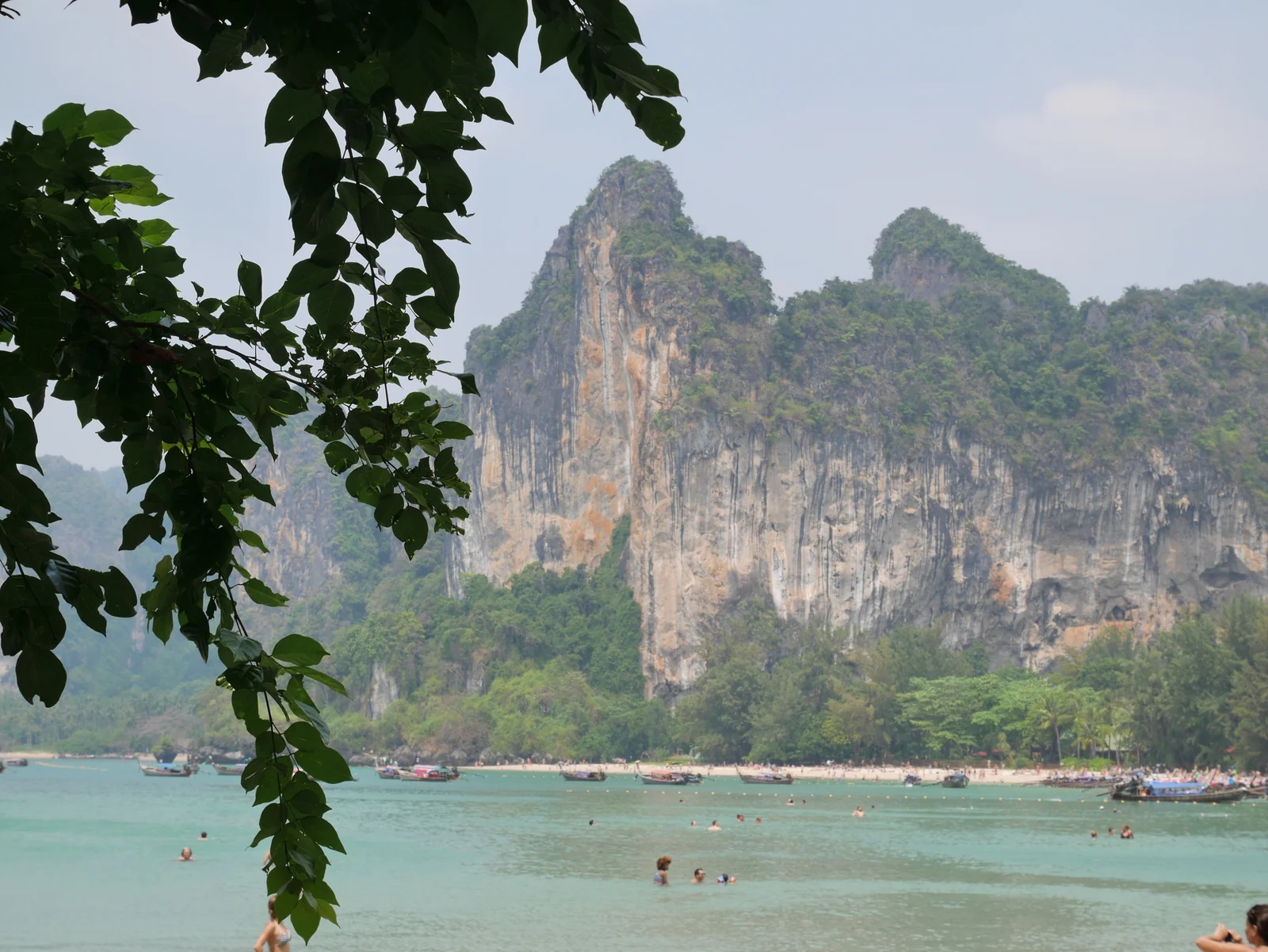
The Railay peninsula is the reason the resort exists in the form it does. Towering limestone karsts close off three beaches into a pocket of the Andaman that feels separate from Krabi proper. Rayavadee sits in the middle of it, on roughly 10.5 hectares of protected ground inside Krabi Marine National Park (Thailand Lifestyle, 2026). The trade off is built into the geography. Everything that makes the setting feel private also makes it slow to leave, and the same beaches that empty out at dusk fill with day boats by late morning.
The short version is that Rayavadee looks strongest for a honeymoon, an anniversary, or any stay where the point is to stop moving. The pavilions, the cave restaurant, and the seclusion reachable only by boat are the main draw. The catch is the premium price and the isolation that comes with it. If you book it for slowness and scenery, it makes sense. If you book it expecting a walkable resort town outside the gate, the mismatch is easy to see.
 ★ 9.4
★ 9.4
Rayavadee Krabi
What makes Rayavadee different on the Krabi coast
Most Krabi luxury sits in Ao Nang, on a road, with a beach across the street. Rayavadee is the opposite case. The resort occupies the tip of the Railay headland, and the only way in is across the water (Jet Lag Trips, 2026). That single fact does more to define the stay than any amenity list.
The architecture follows the same logic. The pavilions are round, two story structures designed to echo the shape of the karsts around them. The German travel blog Thailand Lifestyle reports that no trees were felled during construction, so the buildings sit inside the existing jungle rather than on cleared ground. There are roughly 102 rooms spread across the property, which is a low density for 10.5 hectares. You feel that space in the gaps between pavilions.
 Photographer: Vyacheslav Argenberg. Source: Wikimedia Commons. License: CC BY 4.0.
The setting buys two things money usually cannot. The first is quiet after the day boats leave. The second is wildlife at close range, with spectacled langurs, macaques, and hornbills moving through the gardens (Sand in My Suitcase, 2026). Both come from the same source. A resort built inside a national park on a roadless headland keeps the jungle pressing in on every side.
Railay is not an island, though almost everyone calls it one. It is a peninsula attached to the mainland by limestone cliffs too steep to build a road through. That technicality is why a 20-minute boat ride stands between you and a place that is, on the map, barely separated from Ao Nang.
Getting there means a boat, and that shapes the stay
Every arrival at Rayavadee ends on the water. From Krabi Airport, the resort runs a van to its pier and then a private speedboat across, around an hour door to door (Pierre Blake, 2026). From Ao Nang, a public longtail covers the same crossing in 20 to 25 minutes. If you are routing through the airport first, you can check transfer options for the Krabi to Railay leg before you arrive.
The boat is part of the appeal and part of the friction. On a calm day the crossing is short and scenic, with the karsts rising straight out of the sea as you approach. In the wettest months from roughly May to October, the Andaman gets choppy, and transfers can be slower or rougher. At low tide the resort sometimes uses tractors to carry guests across the tidal flats at the Railay East pier, which is memorable but not fast.
The practical effect is that Rayavadee is not a base for darting around the region. Once you are in, leaving for half a day elsewhere costs a boat ride each way. That suits a stay built around the resort. It works against a stay built around exploring Krabi widely.
If seas are your concern, the calmest water on the Andaman runs roughly December to March. That window also lines up with the busiest and priciest season at Rayavadee. The May-to-October stretch brings lower rates and greener cliffs, with the trade off of rougher crossings and afternoon rain.
Which pavilion or villa is actually worth booking
The entry category is the Deluxe Pavilion, around 90 square meters, with no private pool (Sand in My Suitcase, 2026). That sounds like a compromise, and for some trips it is. But the resort beaches are a short walk away, and the travel blog Sand in My Suitcase notes they did not miss the pool at all given how close the water sits. If your stay is about the setting rather than your own plunge pool, the Deluxe Pavilion is the value pick.
Above it sit the Terrace and Spa Pavilions, then the villas. The Terrace Pavilion runs about 115 square meters across two floors, with a living room, mini bar, and half bath downstairs and the master bedroom above (Pierre Blake, 2026). The villas climb from there. The Rayavadee Villa is around 417 square meters with a private Jacuzzi pool, and the larger family villas reach 345 square meters and beyond, with private pools and room for six.
One pattern worth weighing comes from the German source. Beach villas sit closer to Railay Beach itself, which means more foot traffic and less privacy during the day, while the jungle pavilions trade the beachfront for seclusion and shade. If privacy is the priority, the pavilions set back into the gardens deliver it better than the beachfront villas, despite costing less.
- Deluxe Pavilion: ~90 sqm, no pool, closest thing to a value rate, from around $1,100 (THB 39,000) per night
- Terrace Pavilion: ~115 sqm, two floors, more living space
- Rayavadee Villa: ~417 sqm, private Jacuzzi pool, two bedrooms
- Family villas: 345 sqm and up, private pool, up to six guests, into the $4,000s (THB 140,000+) at peak
The honest note on the rooms is the decor. More than one account describes the interiors as traditional and dark, heavy on hardwood and Thai craft (Sand in My Suitcase, 2026). Inside the jungle setting that reads as fitting rather than dated. If your taste runs to bright, contemporary, minimalist rooms, this is not that, and the photos can flatter the light more than the rooms hold it.
 Photographer: Christophe95. Source: Wikimedia Commons. License: CC BY-SA 4.0.
The three beaches and the day tripper reality
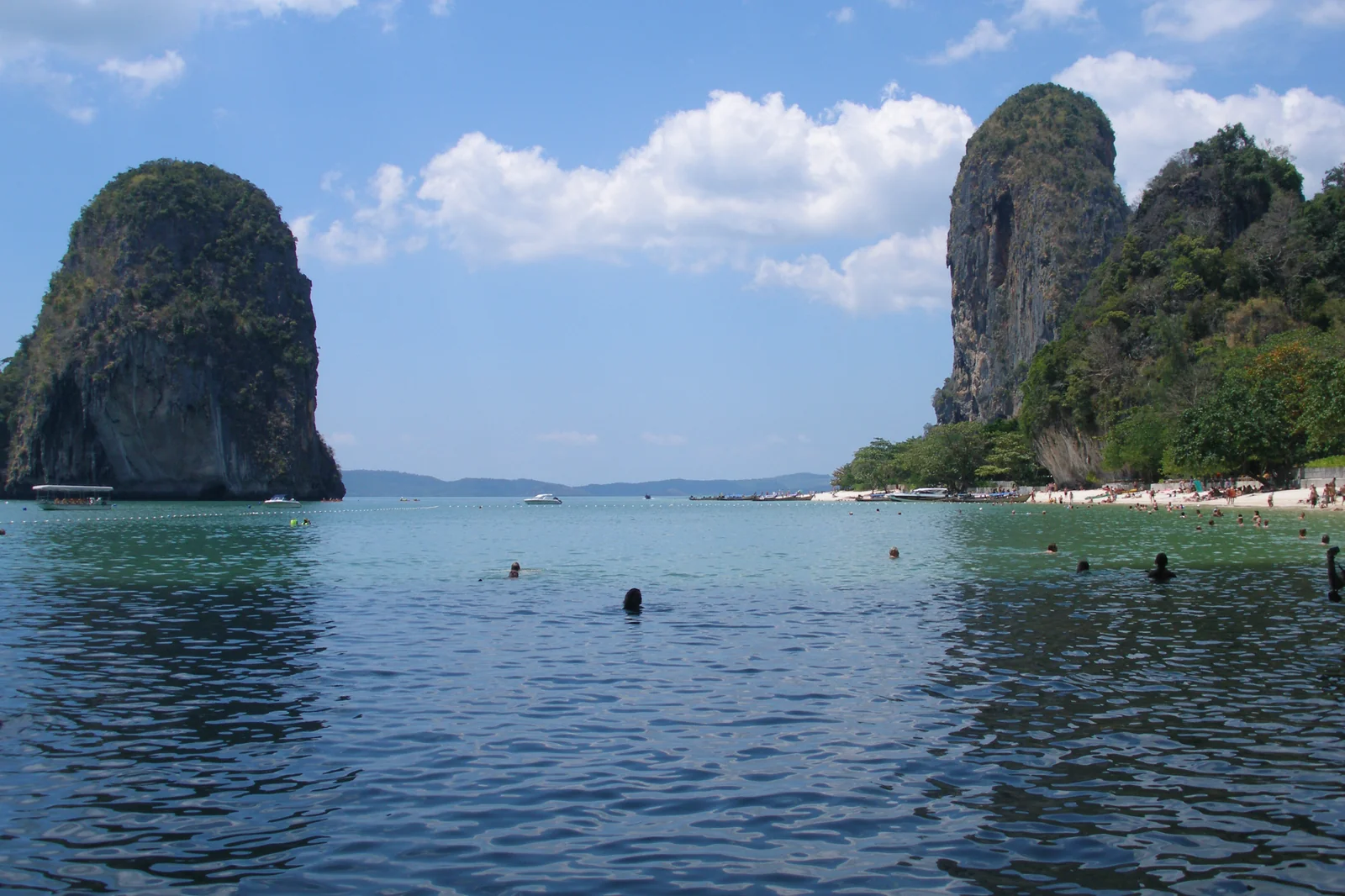
Rayavadee touches three beaches, and they do different jobs. Railay East, where the boats land, is a working arrival beach with a mangrove fringe rather than a swimming strand. Railay West is the postcard, a clean sweep of sand that the German blog calls a “Postkarten-Idylle,” idyllic at sunset once the crowds thin. Phra Nang พระนาง, tucked under the headland, is the one most sources rate the most dramatic beach setting in the country.
Here is where honesty matters. Railay West and Phra Nang are public, and during the day they fill with longtail loads of visitors from Ao Nang and the islands. The quiet that defines Rayavadee in the marketing is real, but it lives in the early mornings and the late afternoons, the windows when the day boats are gone (Sand in My Suitcase, 2026). Staying overnight is what buys those windows. A day visitor never sees them.
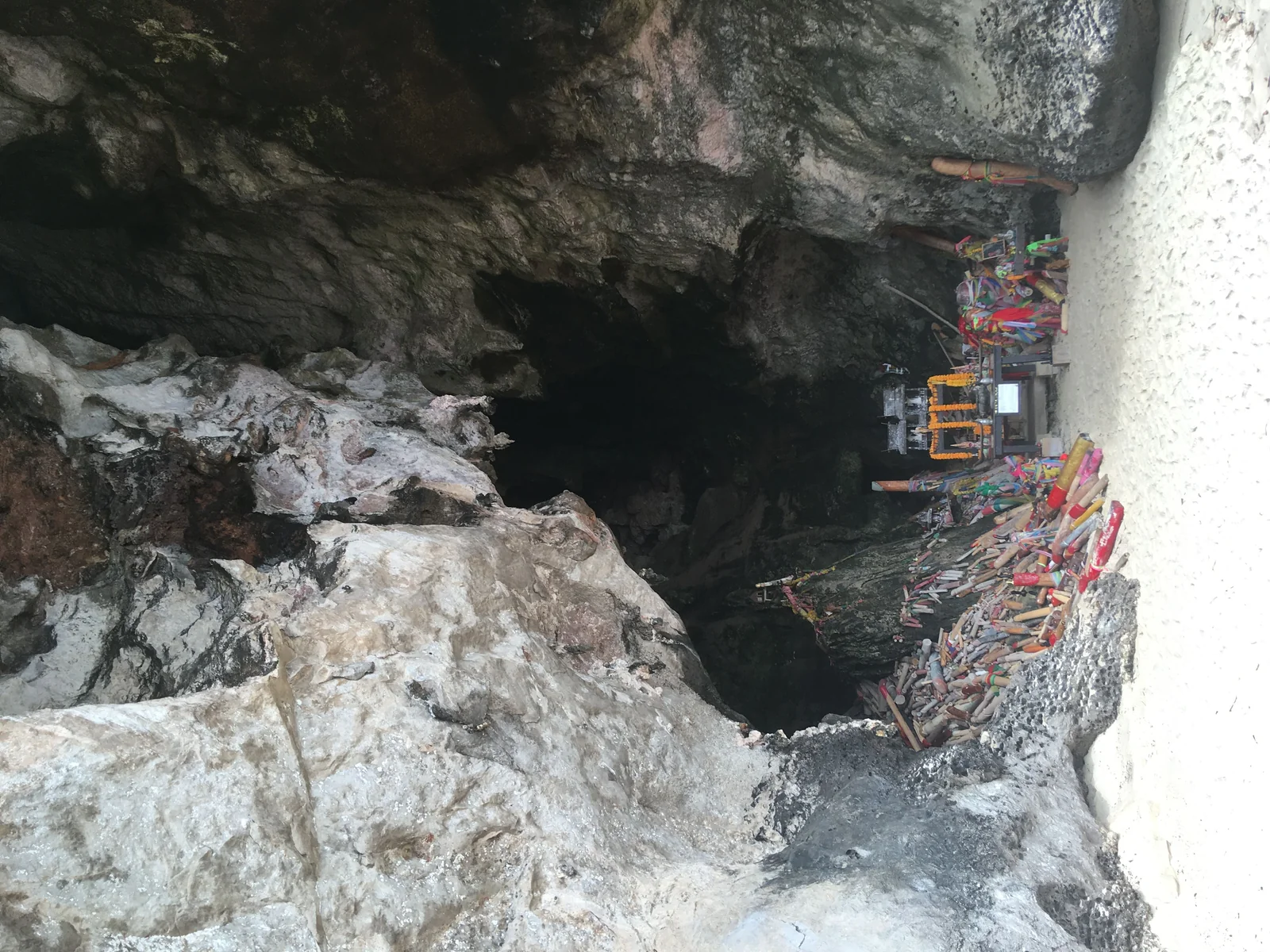
Phra Nang also holds the Princess Cave, a shrine set into the cliff and hung with carved offerings to a sea princess, reachable on foot at low tide. Offshore, the limestone stack of Ko Rang Nok rises straight from the water (Thailand Lifestyle, 2026). These are the details that make the beach feel like more than sand, and they are a short walk from the pavilions rather than a boat trip away.
 Photographer: Sergio Tittarini from Shanghai, China. Source: Wikimedia Commons. License: CC BY 2.0.
Dining, from the cave restaurant to Krua Phranang
The dining story starts with The Grotto. The restaurant sits inside a limestone cave at the edge of Phra Nang Beach, with stalactites overhead and the water a few meters from the tables (Thailand Magazine, 2026). It runs as a venue focused on guests, and the sunset barbecue is the slot guests request most. As a piece of theater it is hard to match anywhere in Thailand, and it is the kind of setting a special occasion trip is built around.
Krua Phranang is the everyday Thai option, a beachfront restaurant on Phra Nang with teakwood terraces and views back toward the karsts. The Raya handles international fine dining, and the Raitalay Terrace covers breakfast and Thai-Mediterranean plates on Railay Beach. Four kitchens for one resort is generous, and the isolation makes it necessary, because there is no walking out to a town for dinner.
Two caveats come straight from guest accounts. The first is the heat, with one report noting the Thai restaurant stayed warm despite the ceiling fans. The second is the wildlife, and it is funnier in hindsight than in the moment. A macaque dropped from a restaurant roof and snatched food off the table (Sand in My Suitcase, 2026). The jungle setting that makes the resort special also means you guard your plate.
What guests across stays report most
The praise is consistent across languages. English, French, German, and Italian sources land on the same words: the setting, the seclusion, the staff. The Italian reviewers describe arriving and feeling like they are on another planet, with the access only by boat doing the work. The French blog Jet Lag Trips calls it an enchanted escape and rates the service close to flawless.
The criticism is consistent too, and it clusters on value rather than quality. At this price band the bar is high, and a minority of recent guests feel the service did not always clear it. The setting reliably delivers. The service is the variable that occasionally slips, and when a Deluxe Pavilion starts above $1,100 (THB 39,000) a night, a slip registers more than it would elsewhere.
The pattern that matters most for booking is the gap between day and night. Guests who treat Rayavadee as a place to slow down for several nights report the strongest stays. Guests expecting a lively, walkable resort scene are the ones most likely to feel the isolation as a limitation rather than a feature.
What to know before you commit to the price
Rayavadee is a longstanding Leading Hotels of the World property, and it is SHA certified in Krabi, so the hygiene and safety baseline is covered. The harder questions are about fit and money, not standards.
The price is the first filter. This is a resort priced in the four figures per night even at the entry pavilion, climbing well past $4,000 (THB 140,000) for the top villas in high season. The December-to-March window brings the calmest seas and the highest rates together. The May-to-October stretch trades rougher crossings and afternoon rain for noticeably lower prices and greener cliffs.
The second filter is mobility. No road means every outing is a boat ride, and that turns spontaneous half days into planned logistics. If you want to climb at Tonsai, hop by boat to Phi Phi, or eat around Krabi Town, factor the crossings in. You can compare boat transfers for the Krabi to Railay route when you plan the surrounding days.
The third filter is taste in rooms. The pavilions are large, well kept, and built from dark hardwood in a traditional Thai register. That suits the jungle. It will not suit someone who wants a crisp, modern room full of light, and that is worth being honest with yourself about before paying the rate.
Who this resort suits, and who should look elsewhere
Rayavadee fits couples and honeymooners who want scenery, seclusion, and a reason to barely leave the property. It fits travelers who read the boat ride as part of the experience, who want langurs in the trees and a cave restaurant for the anniversary dinner, and who are happy to spend several slow days inside one place. For that trip, the price buys something genuinely rare on the Andaman, and it is worth a look at current rates and availability at Rayavadee early, since the best pavilions book out in high season.
It fits less naturally for travelers who want to roam. If your Krabi plan is built around climbing, diving, hopping between islands, and eating across town, the isolation works against you and the rate is hard to justify for a base you keep leaving. Budget-minded visitors and anyone who prizes a bright contemporary room over a jungle and hardwood mood will find better fit, and better value, elsewhere on the coast.
Alternatives to consider on the same coast
If you are still deciding on area rather than just hotel, these are the comparisons that matter most:
- Banyan Tree Krabi sits on the mainland near Tubkaak with road access, which trades Railay’s drama for far easier movement around the region. Our Banyan Tree Krabi review covers the pool villas in full.
- Six Senses Yao Noi offers the same seclusion reachable only by boat across Phang Nga Bay, with a different, more contemporary villa style.
- Staying in Ao Nang itself keeps you on a road with restaurants and boats at the door, at a fraction of the rate, with the trade off of a busier and less private setting.
For the wider picture, see our roundup of the best SHA-certified hotels in Krabi to weigh setting against access before you lock in a base. To plan the days around the stay, see our guide to 3 days in Krabi.