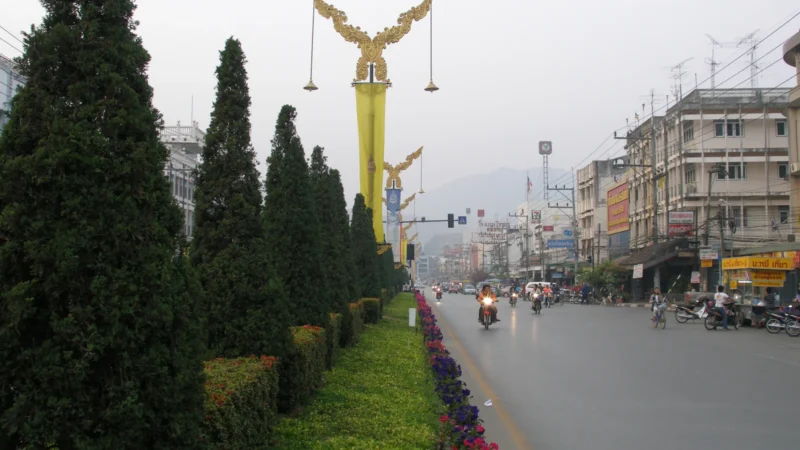
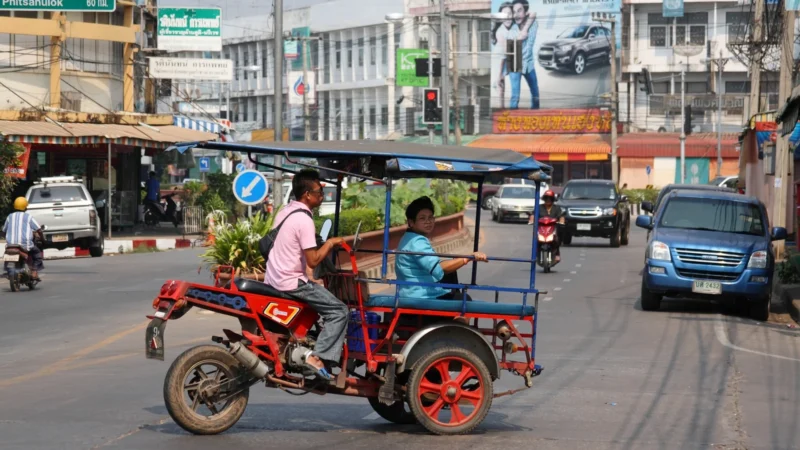
The Chiang Mai to Chiang Rai run is 182 km up Highway 118, and every scheduled seat on it leaves from Arcade Terminal 3. Search the leg and you’ll get handed four ways to travel, then a booking widget. That framing is wrong, because one company runs the entire scheduled service. There’s no operator to pick between. What’s actually left to decide is a seat class, where you buy the ticket, and which of Chiang Rai’s two terminals you step off at.
Two of those three change what you pay. The identical Express seat runs about $8 (THB 285) at the Arcade window and roughly $11 (THB 397) on an online listing. Same coach, same running time, different channel. Before you commit to a cabin, look at current departures and seat classes on the corridor.
The rest of the day is simple once you know its shape. Between 11 and 13 services run from roughly 07:00 to 18:30. The quickest cabin covers the road in 3 hours 20 minutes. The cheapest useful one takes 3 hours 45. If you want the fastest scheduled seat, hold out for V-Class. If you’re counting baht, Express costs a hundred less and lands 25 minutes later. Skip the flight unless you’re already connecting through Chiang Mai on a ticket that carries the onward leg.
 Photographer: Basile Morin. Source: Wikimedia Commons. License: CC BY-SA 4.0.
One operator, 182 km, and three decisions that cost money
Start with the corridor, because it settles most of the booking. The road runs 182 km along Highway 118 and then Highway 1, threading between the Khun Chae and Doi Luang national parks. Green Bus is the sole scheduled operator on it. Every class below is the same company selling a different cabin.
The numbers that actually decide the trip:
- Distance: 182 km along the Highway 118 corridor, quoted as 185 to 200 km door to door.
- Fastest cabin: V-Class, 3 hours 20 minutes, 24 seats, three across.
- Cheapest useful cabin: Express, 3 hours 45 minutes, up to 48 seats, four across.
- Budget classes at the counter: A-Class from $6 (THB 220), X-Class from $7 (THB 260).
- Main classes at the counter: Express $8 (THB 285), V-Class $12 (THB 400).
- Frequency: 11 to 13 departures daily, first near 07:00, last near 18:30.
- Departure point: Chiang Mai Bus Terminal 3, the Arcade terminal in Tambon Wat Ket.
- Arrival points: Chiang Rai Terminal 2 south of town, then Terminal 1 in the center.
- Rail: none. Chiang Rai has no railway station.
That last line deletes a whole category of itinerary. Thailand’s northern line stops at Chiang Mai, so any plan involving a train is a bus with extra steps in front of it. Our Chiang Mai train guide covers the leg where rail does work, which is the one from Bangkok. North of Chiang Mai, the road is the route.
What the seat costs at the Arcade counter versus online
Fares here diverge more by purchase channel than by class, and no competing guide flags it. Aggregator and reseller listings put Express near $11 (THB 397). A traveler buying the same seat at the Arcade window paid about $8 (THB 285). That’s roughly a 37 percent premium for booking from your phone.
The premium cabin carries the same spread. V-Class shows around $12 (THB 400) direct against near $17 (THB 602) through the online layer. So the rule is short. Buy at the counter when your dates are loose and you can absorb a missed departure. Buy online when the date is fixed, when it falls on a weekend, or when you’re landing at Chiang Mai and heading straight north.
Treat any fare you see before you reach the terminal as a ceiling, not a quote. THB 397 for Express and THB 602 for VIP are online layer numbers. The Arcade counter runs closer to THB 285 and THB 400. Knowing both figures lets you decide whether locking a seat in advance is worth the difference on your travel date, instead of discovering the gap at the window.
V-Class against Express, and what 25 minutes is worth
The upgrade buys 25 minutes and a seat width. It isn’t a different journey. V-Class is a 24 seat coach in a three across layout, with reclining seats, foot rests, individual air vents, a toilet on board, a snack and a meal. Around six departures spread between 07:30 and 18:30, and the road takes 3 hours 20 minutes.
Express and X-Class are the four across cabins, 40 to 48 seats, with a toilet on board, a snack and air conditioning. Roughly seven departures run from 07:00 to 18:15, and the road takes 3 hours 45 minutes. On a leg this short, 25 minutes is a weak argument for paying up unless you’re tall or you plan to sleep.
Two things stop this from being a clean ladder. The first is fleet variation. Riders report that coach age varies across the corridor, so the seat you get on a given departure is not always the newest one in its class. Reviewers also note overhead bins of roughly 10 inches on the northern coaches, which is shallow for a standard carry on (Tieland to Thailand). Passengers describe the cabin air conditioning as cold enough that regulars pack a layer for a daytime run.
The second is the seat lottery, and it matters more than the class does. On the four across cabins that work this corridor, several rows sit beside the toilet, and riders who’ve done the leg say to pick a seat away from them (The BeauTraveler). Announcements are usually in Thai or limited English, so track the road yourself. Sources also disagree on whether the express run takes the halfway rest stop, so eat before you board.
Arcade Terminal 3 out, and the Terminal 2 trap on arrival
The departure end is fixed. Every scheduled service leaves from Chiang Mai Bus Terminal 3, the Arcade terminal in Tambon Wat Ket. It sits 15 to 30 minutes by taxi from the old city and about 2.2 km from Chiang Mai railway station. Budget that transfer on top of the scheduled ride, because it’s the part that makes people miss an early departure.
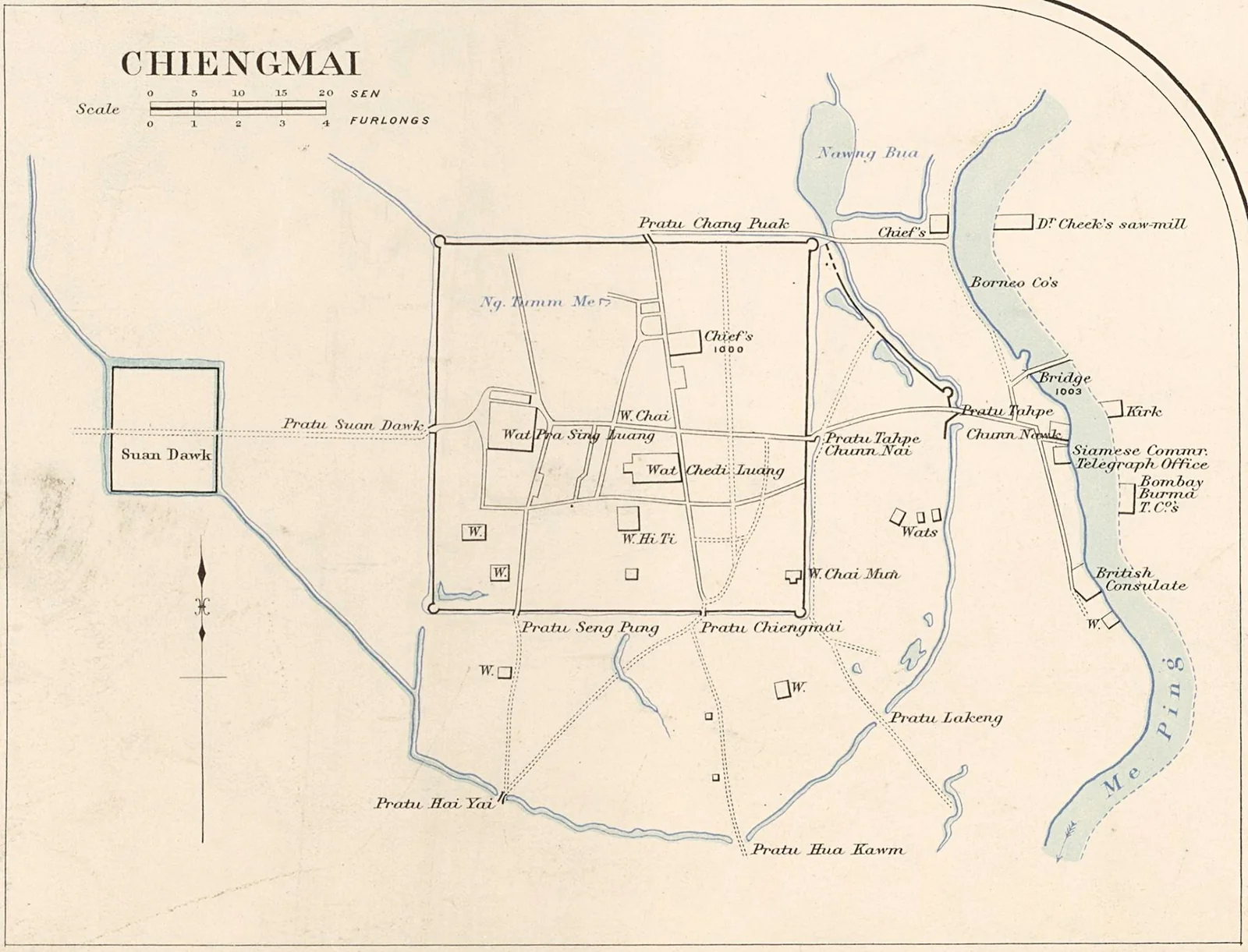 Photographer: James McCarthy (1853–1919). Source: Wikimedia Commons. License: Public domain.
The arrival end is where guides contradict each other, and the contradiction costs money. The coach calls at Chiang Rai Bus Terminal 2 first, 6 to 7 km south of town on the Superhighway, then continues to Terminal 1 in the center near the Night Bazaar. Both stops sit on the same ticket. English guides name one or the other and leave you to guess.
So the rule is short again. Stay on the bus unless your hotel is genuinely south of town. Stepping off at Terminal 2 buys you a taxi fare into the center that the coach would have covered for nothing.
Arcade Terminal 3 isn’t walkable from the old city. Songthaews and metered cars take 15 to 30 minutes depending on how the moat traffic is moving, and the morning build is what kills the 07:00 and 07:30 departures. Agree the fare before you load. Leave the old city an hour ahead rather than 30 minutes, because the terminal is big enough that finding the right bay eats a few minutes on its own.
Private van, day tour, or driving Highway 118 yourself
The alternatives are real, but each has a point where the math turns. A 10 seat Toyota Commuter hires from around $52 (THB 1,800) per day before fuel through Chiang Mai operators. A private transfer with a Wat Rong Khun stop built in sits near $105 (THB 3,600). Split four or more ways that lands close to bus money, with hotel pickup and a temple stop included. For two people it’s roughly four times the Express fare for the same arrival window.
Day rate quotes also routinely exclude fuel and driver expenses, so confirm what the number covers before you agree to it. The vehicle isn’t standardized the way a bus class is either, which is why one operator’s THB 1,800 and another’s THB 3,600 can describe the same journey. If the group is large enough to make it work, compare private transfer options first.
The organized day tour is a different product. It bundles Wat Rong Khun, Wat Rong Suea Ten and the Baan Dam Museum with hotel pickup from about $35 (THB 1,200). The cost is time. Riders report around 8 hours in the van across the round trip, inside an 11 to 12 hour day (I Travel for the Stars). That leaves 4 to 5 hours on the ground for three sites, and it lands you at the White Temple in the coach window rather than at the quiet 08:00 opening.
Take the tour only if one spare day is genuinely all you have. If you can spare two nights, ride the bus and book the temple entries separately.
Self driving suits confident drivers who want the Mae Kachan hot springs or the roadside coffee stands. Running costs on a leg this short are small:
- Rental car: $29 to $43 (THB 1,000 to 1,500) per day.
- Fuel: a full tank near $4 (THB 150) covers more than 200 km.
- Driving time: 3 to 3.5 hours on Highway 118 then Highway 1.
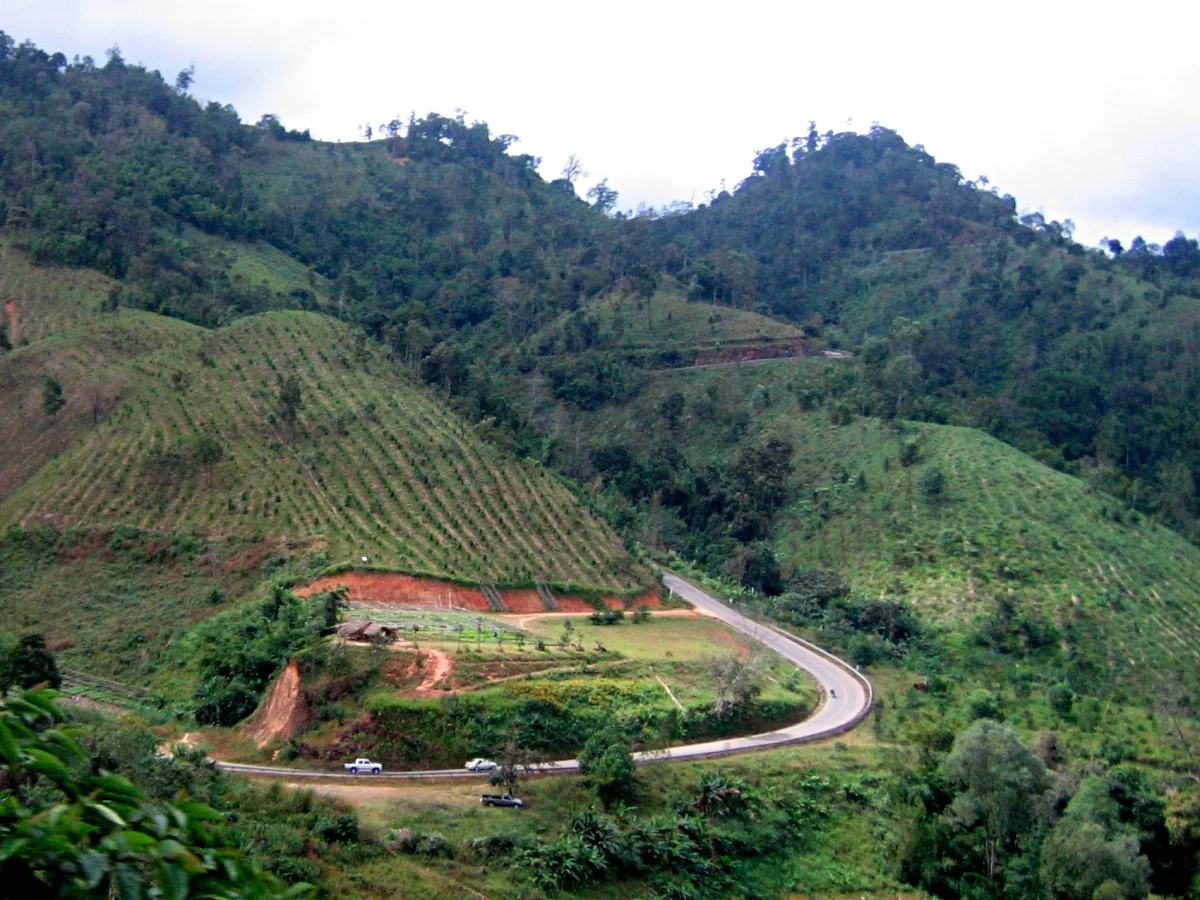
The road is the catch. Highway 118 is a mountain route with switchbacks and sustained elevation change. That’s why rental shops refuse to release a 125cc scooter for it and push riders onto 150cc or larger (Unmapped Asia). A scooter also leaves you carrying luggage through three hours of curves. Renting one way means arranging a drop off in Chiang Rai, not paying the flat day rate the quote implies. Compare rental rates and drop off terms before you assume that rate holds.
 Photographer: Lerdsuwa/Somporn Jitporkkasem. Source: Wikimedia Commons. License: CC BY-SA 3.0.
The flight that costs nine times the bus fare
Yes, you can fly it. Thai AirAsia, Thai Vietjet and Thai Lion Air run the nonstop hop, and Mae Fah Luang Chiang Rai International sits about 9 km from the city. Air time is roughly an hour. The arithmetic is the problem. One way fares start near $73 against $12 for the fastest coach, about nine times the price to cover 182 km. You can check current fares on the hop if you want to test that yourself.
Airport procedures and the 9 km transfer into town then give back most of the hour you bought. Schedules on the pair are thin, and the cheapest fares cluster in low demand months. We rate the flight worth costing out only if you’re connecting through Chiang Mai International on a ticket that already carries the onward leg. Otherwise the road wins on every measure that counts. Our guide to flying inside Thailand covers the legs where a plane earns its fare, and the Chiang Mai flights guide covers the northern one that justifies a plane.
Booking ahead, and what to do when every seat is gone
Midweek outside peak, the Arcade counter will usually seat you on the next service, and there’s no reason to prebook. Weekends, Thai public holidays and the December to February peak change that. Thai travelers post regularly about finding every scheduled departure on the corridor already taken for the day. That’s the failure mode the English guides never mention.
Plan for it rather than react to it. Either book online for a fixed date and absorb the channel markup, or reach Arcade early and take whatever class is still selling. If the day really is gone, the fallback ladder runs in order. A shared van from the terminal first. Then a private transfer split with other stranded travelers. Then a night in Chiang Mai and the first departure the next morning. The flight is the expensive last resort, not the first fix.
Getting from Chiang Rai Terminal 1 to the White Temple
The handoff most travelers fumble happens after the bus. Wat Rong Khun sits 13 km south of the city on Highway 1, back toward the road you just rode in on. Local buses leave Terminal 1 from platform 8 every 20 minutes for about $0.60 (THB 20), and the ride takes roughly 30 minutes. The temple opens at 08:00 and closes at 17:00 on weekdays, 17:30 at weekends.
Time it against the coach tours, not against your own body clock. The organized vans out of Chiang Mai land in the middle of the day. An early arrival on the first bus north gives you the temple before the loudspeakers start moving people through it.
Folding the north into a longer trip changes the timing again. Our 3 days in Chiang Mai itinerary and the things to do in Chiang Mai roundup cover the other end of the corridor. The 10 day Thailand itinerary shows where the north fits in a longer route, and when to visit Thailand sets the months.
Where to stay once you reach Chiang Rai
All three below sit in or beside the center, which is where Terminal 1 leaves you. That matters more here than in a bigger city. Chiang Rai is compact, and the sights spread out along the highways rather than the streets, so a central base saves you the transfers twice a day. Each one works for the temples, the Kok River and a run out toward the border.
For the road back south, our Chiang Mai transport guide covers the long coach leg, and the Pai minivan run covers the other mountain road out of Chiang Mai. If you’re basing yourself in Chiang Mai first, start with the best SHA hotels in Chiang Mai.


See also our Chiang Rai transport guide.
Frequently asked questions about the Chiang Mai to Chiang Rai bus
How long is the bus from Chiang Mai to Chiang Rai?
How much is the bus from Chiang Mai to Chiang Rai?
Is there a train from Chiang Mai to Chiang Rai?
Which bus terminal in Chiang Mai goes to Chiang Rai?
Which Chiang Rai bus terminal does the bus arrive at?
Do you need to book the bus in advance?
Can you fly from Chiang Mai to Chiang Rai?
Is Chiang Rai worth visiting as a day trip?
We rank this corridor on the numbers that change the booking, not on the mode that sounds best. See how we test and rank for the method behind these calls.