The first time we walked Chiang Mai Old City (เชียงใหม่) end to end, we did it before sunrise. The moat-bordered square measures 1.5 kilometers per side. The walls were laid down in 1296 by King Mengrai when he founded the Lanna capital. Inside the moat sit more than 30 active temples, the Three Kings Monument at the center, and four named gates anchoring four very different walking circuits. From Tha Phae Gate on the east to Suan Dok Gate on the west took us 22 minutes at a temple-counting pace. Pick the right gate to anchor each day and the Old City arranges itself around walking minutes and a 19 THB ($0.55) donation slot.
Pick the wrong cluster and Chiang Mai feels like a Grab receipt back to Nimman. This Old City Chiang Mai guide walks the four gates the way locals plan their visits: by cluster, by wat, by what kind of day you want. Our internal yardstick is the SHA review methodology, which only covers properties with active TAT certification.
Old City Chiang Mai, a 1.5 kilometer square of wats and lanes
The Old City (เมืองเก่า) is a square measured in walking minutes, not kilometers. The moat runs four sides at 1.5 kilometers each. The remaining brick wall sections at the four gates show the original Lanna defensive layout. King Mengrai founded the city in 1296 as the capital of the Lanna Kingdom. The walls held until the Burmese siege of 1558 and the recapture in 1774. The brick you see at Tha Phae Gate today is a 1980s reconstruction. The moat itself is original.
Inside the walls sit the temple cluster that drives most first-time itineraries. Wat Phra Singh (วัดพระสิงห์) anchors the western end inside Suan Dok Gate. Wat Chedi Luang (วัดเจดีย์หลวง) sits at the center off Phra Pokklao Road. Wat Chiang Man (วัดเชียงมั่น) is the oldest temple in the city, founded the same year as the walls. The remaining 27 plus active wats spread between them on a grid of small lanes wide enough for one motorbike and one person.
The pattern most useful to first time visitors is by gate, not by temple. Each gate anchors a different walking circuit. Tha Phae on the east is the visual entry and the Sunday Walking Street start. Suan Dok on the west covers the Wat Phra Singh cluster and the Doi Suthep road. Chiang Mai Gate on the south opens onto Wualai and the Saturday Walking Street. Chang Phueak on the north fronts the quieter wall and a local market most visitors never reach.
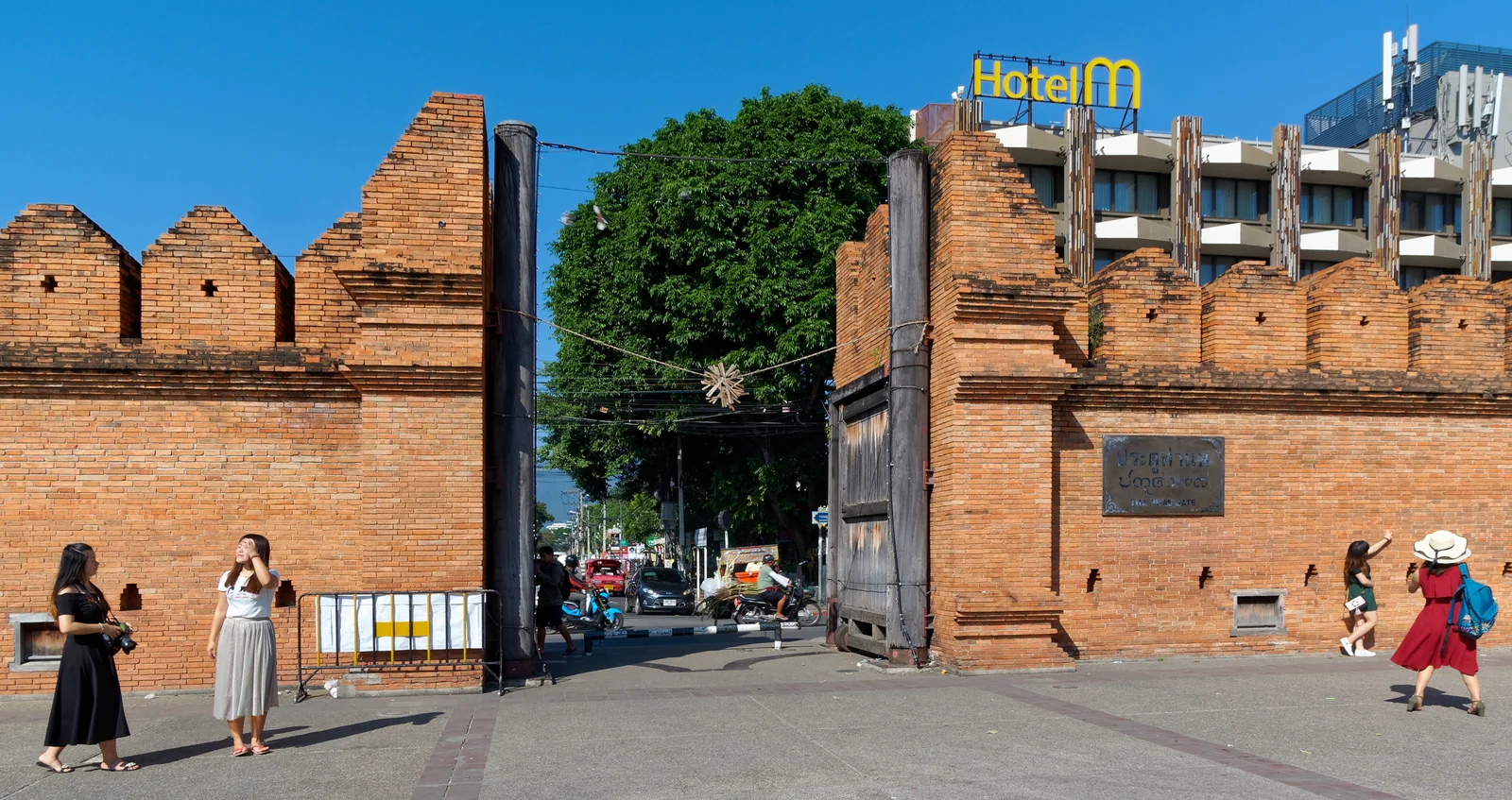 Photographer: Jakub Hałun. Source: Wikimedia Commons. License: CC BY-SA 4.0.
Tha Phae Gate (east), the main entry and Sunday Walking Street start
Tha Phae Gate (ประตูท่าแพ) sits at the eastern moat wall on Ratchadamnoen Road. The plaza in front is the most photographed corner of Chiang Mai. The wide brick face turns gold at sunset and the pigeons swirl off the wall on the same predictable rhythm every evening. We have spent three separate evenings on the plaza with a coffee from Akha Ama Coffee (a 90 second walk inside the gate). The light shifts at 6:15 in November and 6:50 in May.
The cluster around Tha Phae carries the most foot traffic in the Old City. Akha Ama Coffee runs the most consistent third-wave pour-over inside the moat. Lila Thai Massage on Ratchadamnoen offers 250 THB ($7) hour massages staffed by graduates of the Chiang Mai Women’s Correctional program. The line of cafes, vegan kitchens, and silver shops runs four blocks deep into the city before the residential lanes take over.
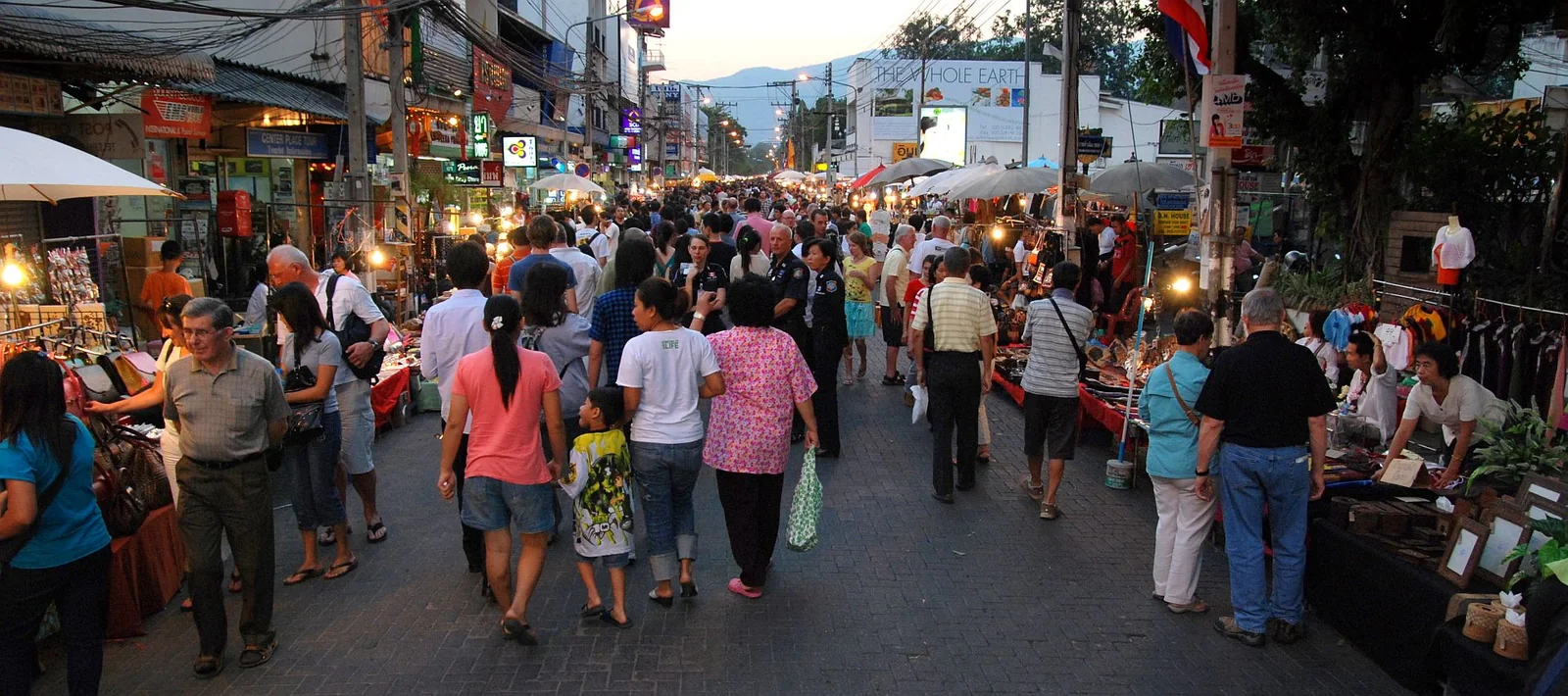
Tha Phae is also the official start of the Sunday Walking Street. Every Sunday from 4pm to 10pm the 1.2 kilometer length of Ratchadamnoen closes to traffic. The market runs from the gate plaza west to Wat Phra Singh. Sai ua northern sausage stalls, mango sticky rice at 50 THB ($1.40), and live music on temple grounds along the route fill the route. The walk takes 30 minutes on a quiet Sunday and 90 minutes on the first November cool-season weekend.
The Tha Phae plaza hotels charge a 30 percent premium over equivalent rooms two soi north or south. The photogenic address adds noise and rate. Reach for a hotel one soi inside the gate, not directly on the plaza, and the same room runs $40 to $80 less.
Wat Phra Singh and Suan Dok Gate (west), the temple cluster and Doi Suthep launchpad
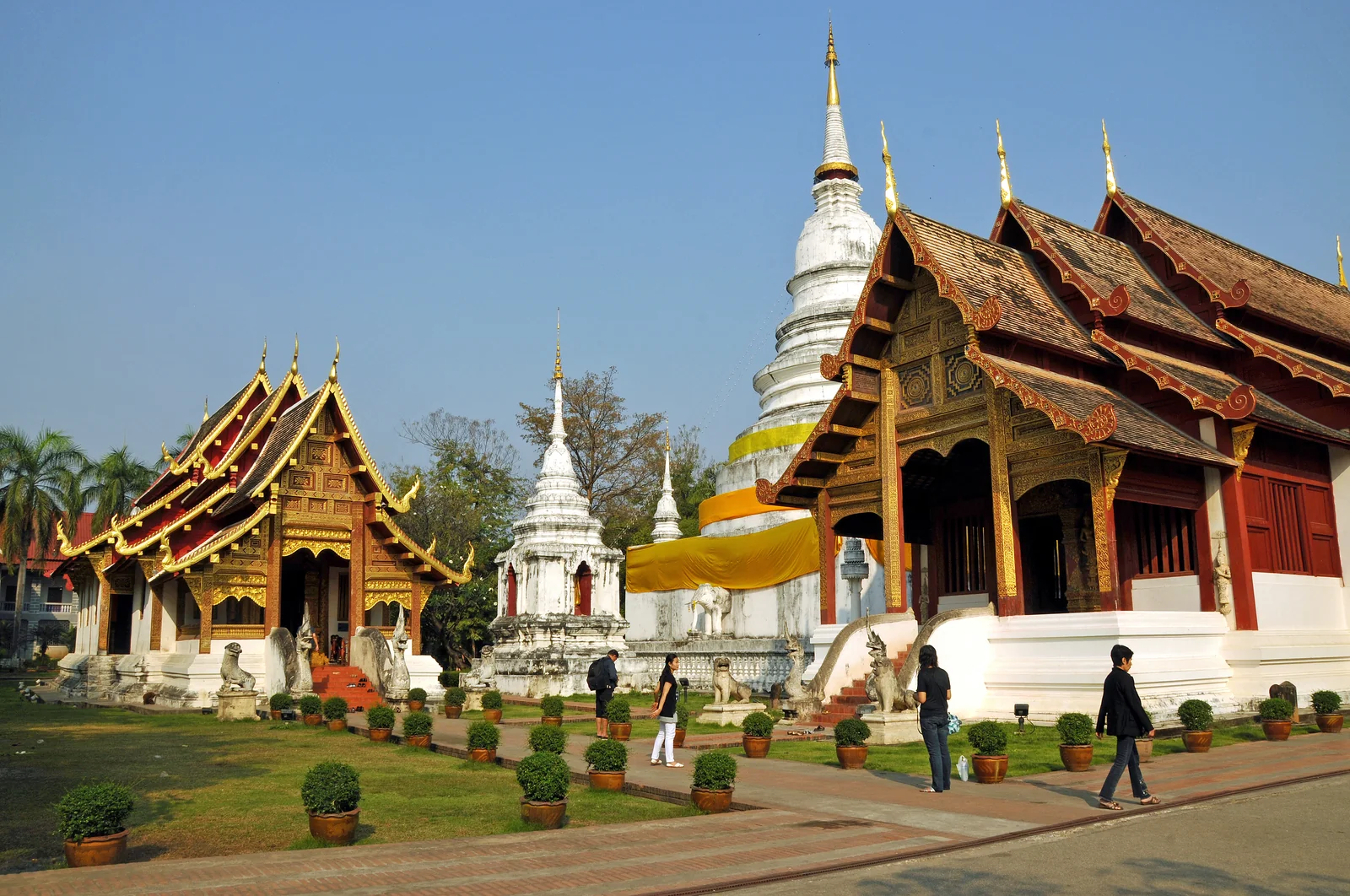
Suan Dok Gate (ประตูสวนดอก) sits on the western moat wall. The gate itself is the quietest of the four. Most foot traffic flows past it toward Wat Phra Singh just inside, or out of it toward the Doi Suthep road. Wat Phra Singh anchors the western end of the Old City and the western end of the Sunday Walking Street route. The temple complex is free to enter. The inner Phra Singh Buddha shrine takes a 19 THB ($0.55) donation slot and closes at 5pm.
Returning visitors consistently flag Wat Phra Singh as worth an early start. The calm window is 7am to 9am. The Doi Suthep tour buses arrive around 11am and discharge groups into the temple courtyard for 30 minute photo stops. The light on the gilded viharn between 7am and 8am cuts cleanly across the courtyard. Monks chant from the inner hall in the same early window. The temple is residential at that hour, not touristic.
Past Suan Dok Gate the road runs west toward Doi Suthep mountain. The mountain temple (Wat Phra That Doi Suthep) is one of the highest-traffic day trips in northern Thailand. The 15 kilometer drive takes 30 minutes on a clear road and 55 minutes on a Songkran or Loy Krathong weekend. Songthaew (red truck) shared rides leave from the Chang Phueak gate on the north and the Suan Dok area on the west at 80 THB ($2.30) per person each way.
 Photographer: Dennis G. Jarvis. Source: Wikimedia Commons. License: CC BY-SA 2.0.
Wat Chedi Luang and Three Kings Monument (center), the historic spine
Wat Chedi Luang (วัดเจดีย์หลวง) sits in the geographic center of the Old City off Phra Pokklao Road. The temple’s signature feature is the half-ruined chedi that once reached 60 meters before the 1545 earthquake brought down the upper third. The remaining 40 meter base is the most photographed Lanna brick structure in northern Thailand. The Lonely Planet entry on the temple covers the 15th century construction history well. Entry is 50 THB ($1.40) for foreigners.
The compound also runs a monk-chat program on Mondays, Wednesdays, and Fridays from 9am to 6pm. Visitors sit on stone benches along the western wall while novices practice English in 15 minute conversations. The exchange is genuinely two-sided. We have walked into the chat at 4pm twice. Both times the monks asked careful questions about Bangkok prices and our route. Both times we ended the conversation with the same one-line donation suggestion and no pressure.
The Three Kings Monument (อนุสาวรีย์สามกษัตริย์) sits two blocks north of Wat Chedi Luang at the intersection of Ratchadamnoen and Phra Pokklao. The bronze monument depicts King Mengrai (Chiang Mai founder), King Ngam Mueang (Phayao), and King Ramkhamhaeng (Sukhothai) discussing the city plan in 1296. The Chiang Mai City Arts and Cultural Center sits directly behind the monument in a restored 1924 colonial building. The 40 THB ($1.15) entry covers all three centers in the museum cluster.
The Wat Chedi Luang monk-chat is the single highest-leverage cultural exchange inside the Old City. It costs nothing. It runs three afternoons a week. The conversation is genuinely two-sided. Time your visit to a Monday, Wednesday, or Friday in the 4pm to 5pm window.
Chiang Mai Gate (south) and Wualai, the Saturday Walking Street silver street
Chiang Mai Gate (ประตูเชียงใหม่) sits on the southern moat. The cluster around the gate is quieter than Tha Phae on weekdays. The Chiang Mai Gate Market runs every morning from 5am to 9am as a wet market serving the local residential blocks south of the moat. Tourists rarely reach it. The vegetable and sai ua sellers are mostly aimed at neighborhood households, not visitors.
The walking street that matters here is Wualai (ถนนวัวลาย). The road runs south from the gate for about 800 meters. The Lanna silver guild has worked the road since the 1800s. Wat Sri Suphan, the silver temple covered head to toe in hammered aluminum and silver sheeting, anchors the strip 600 meters south of the gate. Every Saturday from 4pm to 10pm the road closes to traffic for the Saturday Walking Street. The market is smaller than Sunday’s. It is also quieter and the silver pieces are sold by the artisans who made them.
The Wualai Saturday market runs roughly 6pm to 8pm at its busiest. The crowd is roughly a third of the Sunday market density. The kuay tiew reua boat noodles at the second street kitchen south of the gate ran 35 THB ($1) per bowl with the same broth depth as the Bangkok originals.
The silver bracelets at the third silversmith we tried priced at $30 to $80 for handmade work with the artisan still at the bench. The trade is genuinely small-batch. The Wat Sri Suphan compound (admission free, closed to women inside the ubosot) sits at the southern end of the strip and worth the 600 meter walk past the food stalls.
Wualai is the quieter Saturday alternative to the Sunday Walking Street. The crowd density runs about a third. The silversmith pieces are sold by the artisan who made them, not a vendor at a folding table. For travelers in Chiang Mai across both weekend nights, Saturday Wualai then Sunday Ratchadamnoen covers both modes without overlap.
Chang Phueak Gate (north), the quieter wall and the local north market
Chang Phueak Gate (ประตูช้างเผือก) sits on the northern moat. It is the gate most travelers never visit. The Chang Phueak Market just outside the gate is the city’s most authentic local night market. The famous Cowboy Hat Lady khao kha moo (stewed pork leg over rice) stall runs from 5pm to midnight at 50 THB ($1.40) per plate. The queue is mostly Thai families and food bloggers from Bangkok. We have eaten there four times. The pork-skin gelatin around the meat sets up just right between 7pm and 8pm.
The cluster around Chang Phueak is also the songthaew (red truck) departure point for the Doi Suthep route and the Mae Sa Valley jungle road. The shared rides leave on a roughly hourly schedule between 9am and 4pm. The 80 THB ($2.30) one-way fare runs from the gate to the Doi Suthep temple. The truck only leaves when seven of the ten benches fill. Solo travelers wait 10 to 30 minutes between trucks.
Most Old City itineraries skip Chang Phueak entirely. We think that is a mistake on day three of a stay. The cluster carries the local food scene the four-gate tourist circuit overlooks, and the songthaew anchor makes Doi Suthep a 30 minute ride away without booking a tour.
 Photographer: Takeaway. Source: Wikimedia Commons. License: CC BY-SA 4.0.
Nimman just outside the west wall, the cafe and design-hotel side dish
Nimmanhaemin (นิมมานเหมินทร์), or just Nimman, sits a 14 minute walk west of Suan Dok Gate. The neighborhood is not technically Old City. We include it because most first-time itineraries end up splitting nights between Old City and Nimman, and the trade-off shapes the whole trip. Nimman carries Chiang Mai’s third-wave coffee density, the design hotel cluster, the One Nimman retail and food complex, and the long-stay digital nomad scene.
Ristr8to on Nimmanhaemin Soi 3 is the coffee anchor. The 2017 World Brewers Cup champion runs the bar most mornings. Pour-overs run 130 to 180 THB ($3.70 to $5). The cafe density between Soi 3 and Soi 11 is the highest in northern Thailand. Roughly one specialty cafe per 100 meters. The food scene leans Japanese, Korean, and modern Thai. Most kitchens close by 10pm.
The decision between basing in Old City versus Nimman is real. Old City wins for first-time visitors focused on wats and the Sunday Walking Street. Nimman wins for repeat visitors, digital nomads on a 4 to 8 week stay, and travelers planning more cafe time than temple time. A split stay (2 nights Old City inside the moat, 2 nights Nimman) covers the trade-off without forcing the choice. Lonely Planet’s Chiang Mai entry has been recommending exactly this split for years.
Where to base in Chiang Mai by traveler type
The base decision matters more than the hotel star rating. Pick the wrong neighborhood and the property’s pool deck will not fix it. Our reach for shortlist:
- First-time visitor on a four night trip: Inside the moat, near Wat Chedi Luang or just inside Tha Phae Gate. Most wats and the Sunday Walking Street start at your door.
- Couple on a milestone trip: Riverside, at Anantara Chiang Mai or Raya Heritage. The river breeze beats the moat traffic on a hot evening, and the Old City sits 12 minutes by Grab away.
- Family with kids under 10: Riverside or Nimman. Old City lanes have no sidewalks and the temple etiquette gets exhausting for under-10s. The riverside hotels run swimming pools the Old City boutiques mostly do not.
- Cafe and cocktail visitor or digital nomad: Nimman. The coffee density and the One Nimman cluster carry a long stay without repetition.
- Repeat visitor splitting the trip: 2 nights inside the moat, then 2 nights Nimman or riverside. Covers both modes without committing the whole stay to one.
- Budget-first or backpack trip: Inside the moat, on the smaller sois between Ratchamanka Road and the southern wall. Guesthouses run $25 to $45 a night with breakfast.
Raya Heritage
 ★ 9.1
★ 9.1
Raya Heritage Chiang Mai
Raya Heritage sits on the Mae Ping river 6 kilometers north of the Old City. The hotel is a Lanna craft-driven boutique with handwoven textiles in every room. The riverside pool runs the length of the property. The breakfast buffet leans local with khao soi and sai ua next to the standard Western options. The trade-off is the Grab back to Tha Phae Gate runs 60 to 100 THB ($1.70 to $2.80) each way. There is no in-house shuttle subsidy. For a milestone trip with daily Old City visits, the cost is real but small.
The Heritage Chiang Mai
 SHA EXTRA PLUS
★ 9.3
SHA EXTRA PLUS
★ 9.3
99 The Heritage Hotel
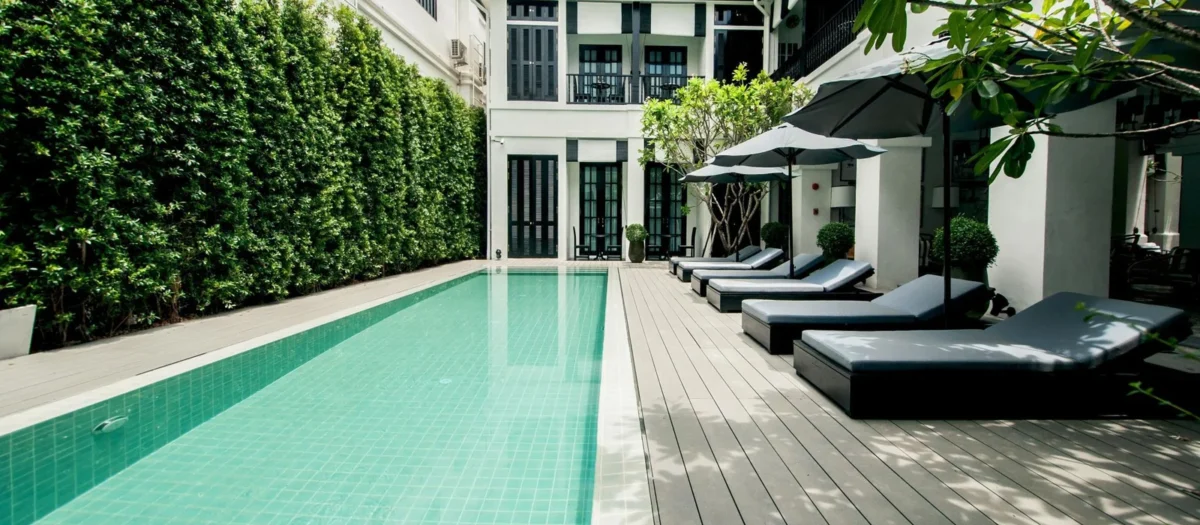
99 The Heritage Hotel earns the highest guest review score of any sub-$100 hotel on this list. The location explains most of it: the property sits 12 minutes' walk from Tha Phae Gate, the eastern entrance to Chiang Mai's Old City and the most photographed corner of the city. For travelers who want walkable Old City access without the international-chain price tag, the math here is hard to beat.
The 60 rooms are spread across a low-rise building wrapped around a courtyard pool. Standard rooms start at 25 sqm with Lanna-influenced wood detailing and a partial city view. The 4th-floor terrace pool is small but rarely crowded. Breakfast is included in all rate plans, served on the 2nd-floor restaurant with a Northern Thai menu that includes proper khao soi and gaeng hung lay alongside the standard Western items. Service is local-staffed and unhurried; the front desk speaks fluent English and can arrange Doi Suthep transfers, cooking class bookings, and night bazaar walking routes within 20 minutes.
The trade-off at this price point is room size and amenity range. There's no spa, no kids' club, no concierge desk in the lobby. Book 99 The Heritage if you want Old City walking access and an authentic Northern Thai breakfast. Skip if you want a five-star service operation.
The Heritage sits on Ratchamanka Road inside the moat, two blocks south of Wat Chedi Luang. The entry rooms run a colonial-Lanna conversion of a 1920s teakwood compound. The walk to Wat Phra Singh takes 7 minutes. The walk to Tha Phae Gate takes 10 minutes. The trade-off is the property runs only 18 rooms, a small pool, and no in-house spa. For a first-time visitor who wants to wake up inside the wat circuit, the location is one of the strongest inside the wall.
U Nimman Chiang Mai
 SHA CERTIFIED
★ 9.2
SHA CERTIFIED
★ 9.2
U Nimman Chiang Mai Hotel
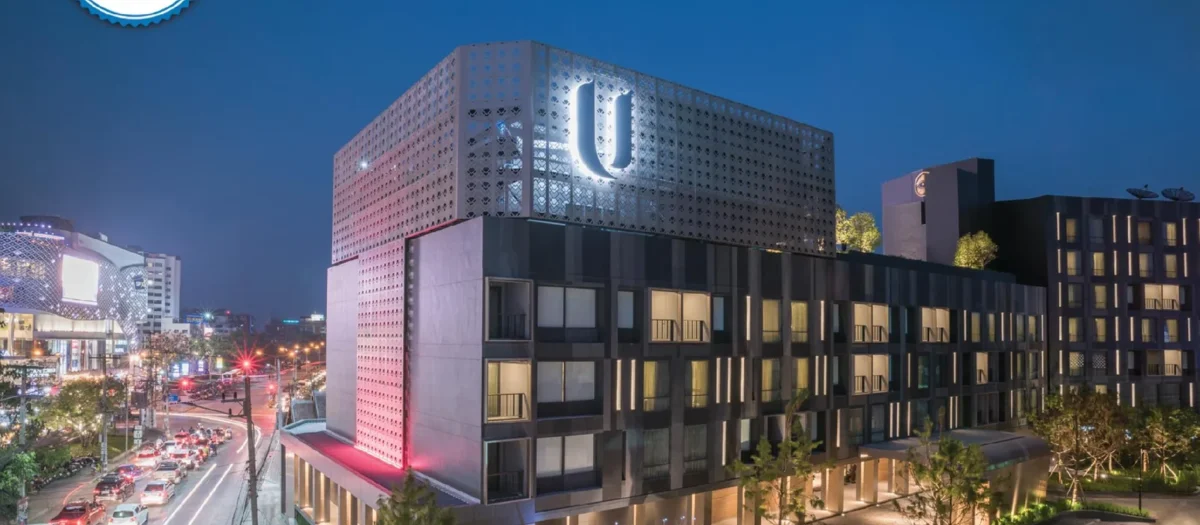
U Nimman runs the highest guest review score of any boutique hotel in central Chiang Mai. The property sits at the intersection of Nimmanhaemin Soi 5 and the One Nimman complex, with 147 rooms in a 7-floor structure that opens onto a central pool courtyard. Repeat-visitor numbers here are high enough that the front desk recognizes regulars by month.
The distinctive feature is the 24-hour stay policy: check-in any time, and your 24 hours start from that moment. Land at midnight, and you keep your room until midnight the next day. Rates start around $95 per night for a deluxe room and run to $210 for a one-bedroom suite. The on-site Trove restaurant runs Northern Thai-meets-Mediterranean cuisine that's one of Nimman's better hotel restaurant programs. The pool is a proper lap-length 25 meters, which is rare in central Chiang Mai.
The location is the strongest amenity: One Nimman is 30 seconds from the lobby (Korean BBQ, specialty coffee, the central food hall), and Maya Mall is 8 minutes' walk. Tha Phae Gate is 8 minutes by Grab (about 80 baht). Book U Nimman if you want the best-rated boutique stay in the Nimman district with unusual flexibility on check-in timing. Skip if you want Old City walking access; the location is Nimman-first.
U Nimman sits on Nimmanhaemin Soi 7 directly across from the One Nimman cluster. The walk to Suan Dok Gate and Wat Phra Singh takes 14 minutes through the western lanes. Coffee at Ristr8to is 4 minutes away. The hotel itself runs a 24 hour breakfast policy that the digital nomad cluster relies on after late nights. The trade-off is Nimman locks into the one neighborhood after dark, and the walk back from a Wat Chedi Luang evening sit runs 22 minutes through residential lanes that go dim past 9pm. Most evenings end in a $2 Grab rather than a stroll.
Getting around the Old City, on foot first then Grab
The Old City has no rapid transit. Chiang Mai does not run a BTS or MRT. The default tool is your feet. Inside the moat, almost everything sits within a 20 minute walk of everything else. The fare math for the rest:
- Grab Old City to Nimman runs 60 to 90 THB ($1.70 to $2.50) one way.
- Grab Old City to riverside hotels runs 80 to 110 THB ($2.30 to $3.10).
- Songthaew (red truck) inside the moat runs a flat 30 THB ($0.85) on most short hops, negotiable.
- Tuk-tuk inside the moat opens at 150 to 200 THB ($4.30 to $5.70). The honest rate is $3. Negotiate.
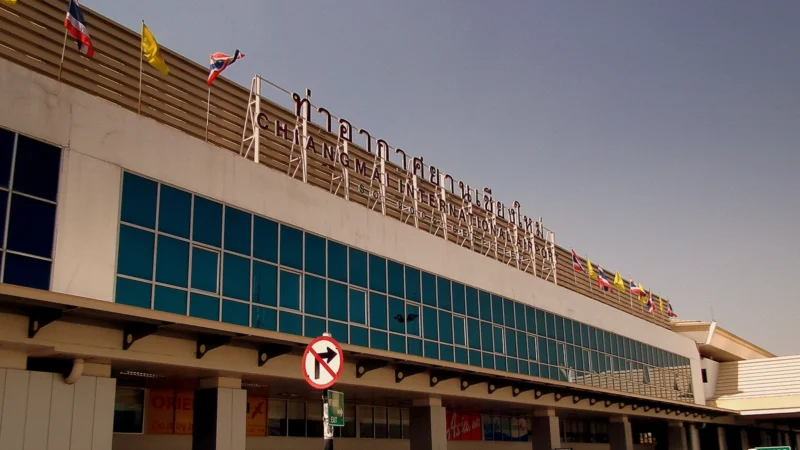
- CNX airport to the Old City runs 150 to 200 THB ($4.30 to $5.70) by Grab or about $6 by metered taxi.
Grab is the default rideshare. Meter taxis run cleanly at the airport and rarely refuse the meter inside the city. Tuk-tuks open 2 to 3 times the Grab fare and require a firm counter. The German practical guide Reiselife notes the same negotiation pattern across northern Thailand. The cooling on a 33 degree April afternoon in any tuk-tuk is nonexistent.
For airport transfers, see live private transfer rates. For inside-the-moat rooms at The Heritage, check live availability. For day trips to Doi Suthep, Mae Sa Valley, and the elephant sanctuaries, see our best things to do in Chiang Mai guide. For our city-wide itinerary, see 3 days in Chiang Mai.
Burning season, Songkran, and the calendar windows that change the trip
Two windows in the Chiang Mai calendar reshape the Old City experience. The first is burning season. From late February through mid-April, agricultural burning across northern Thailand and Myanmar pushes the regional AQI into 300 to 700 plus territory. The Thai-language Pantip threads from 2025 flag this explicitly. Most English guides skip it. The Old City sits inside the smoke pocket. Outdoor sit-down dinners turn unpleasant. Sensitive travelers should reroute to the Andaman or Gulf coasts in this window. Our best time to visit Thailand guide breaks down the regional windows.
The second window is Songkran (สงกรานต์) on April 13 to 15. The Thai New Year water festival turns the moat into a city-wide water fight. Tha Phae Gate is the visual epicenter. The plaza floods with travelers, locals, and the densest concentration of water guns in Thailand. The Old City is closed to most car traffic. Hotel rates inside the moat run 50 to 100 percent above the rest of cool season. The experience is genuinely worth one Chiang Mai trip. It is not the right trip for first-time visitors looking for temple calm.
The third is Loy Krathong (ลอยกระทง) on the November full moon, paired with Yi Peng lantern releases. The Old City lights up with floating krathong on the moat itself and lantern releases mostly outside the wall. The experience is quieter than Songkran but still busy.
The Pantip threads from 2025 are the single most reliable English-readable source for current burning-season AQI numbers in Chiang Mai. Most English travel sites publish the warning months late. Pantip flags it the same day the AQI crosses 200.
Frequently asked questions about Old City Chiang Mai
Is Chiang Mai Old City worth staying in?
What is the best gate to enter Chiang Mai Old City?
How many temples are in Chiang Mai Old City?
Can you walk around Chiang Mai Old City?
Where should I stay in Chiang Mai for first time?
When is the burning season in Chiang Mai?
For more Chiang Mai content, see our best SHA hotels in Chiang Mai roundup, the Four Seasons Chiang Mai review for the Mae Rim luxury alternative, and our best temples in Bangkok guide for the southern wat comparison. To slot Chiang Mai into a wider trip, see the full Thailand itinerary. The Travelfish gate-by-gate breakdown and the Lonely Planet Chiang Mai split-stay recommendation remain two of the most accurate independent reads on the Old City.