No country in Southeast Asia flies its own domestic network as hard as Thailand. Half a dozen carriers fight over short hops to the islands, fares to most airports start near $25 when you book ahead, and the only place that escapes the price war is the one island Bangkok Airways quietly owns. Bangkok itself splits the whole game in two before you even pick a flight, with budget carriers at one airport and full service at another 50 km away.
This pillar covers the airport choice that most travelers get wrong, the airline tiers that explain the price spreads, the season pricing windows that move fares 3x, and links to every individual route guide on the site.
Bangkok’s two airports and why the choice matters
Bangkok runs two commercial airports 50 km apart. The choice of which one your flight uses determines transfer time to the city, terminal experience, and onward connection logistics. Search live fares for popular routes including Bangkok to Phuket, Bangkok to Chiang Mai, Bangkok to Krabi, Bangkok to Koh Samui, and Bangkok to Koh Phi Phi.
- Suvarnabhumi (BKK): 65 million passengers annually, opened 2006, all Star Alliance + oneworld + intercontinental long-haul, all Thai Airways flights, Airport Rail Link to central Bangkok 26-45 min for THB 45
- Don Mueang (DMK): 30 million passengers annually, the older airport refit for low-cost in 2012, AirAsia / Thai Lion / Nok / Thai Vietjet hub, A1 bus to Mo Chit BTS for THB 30
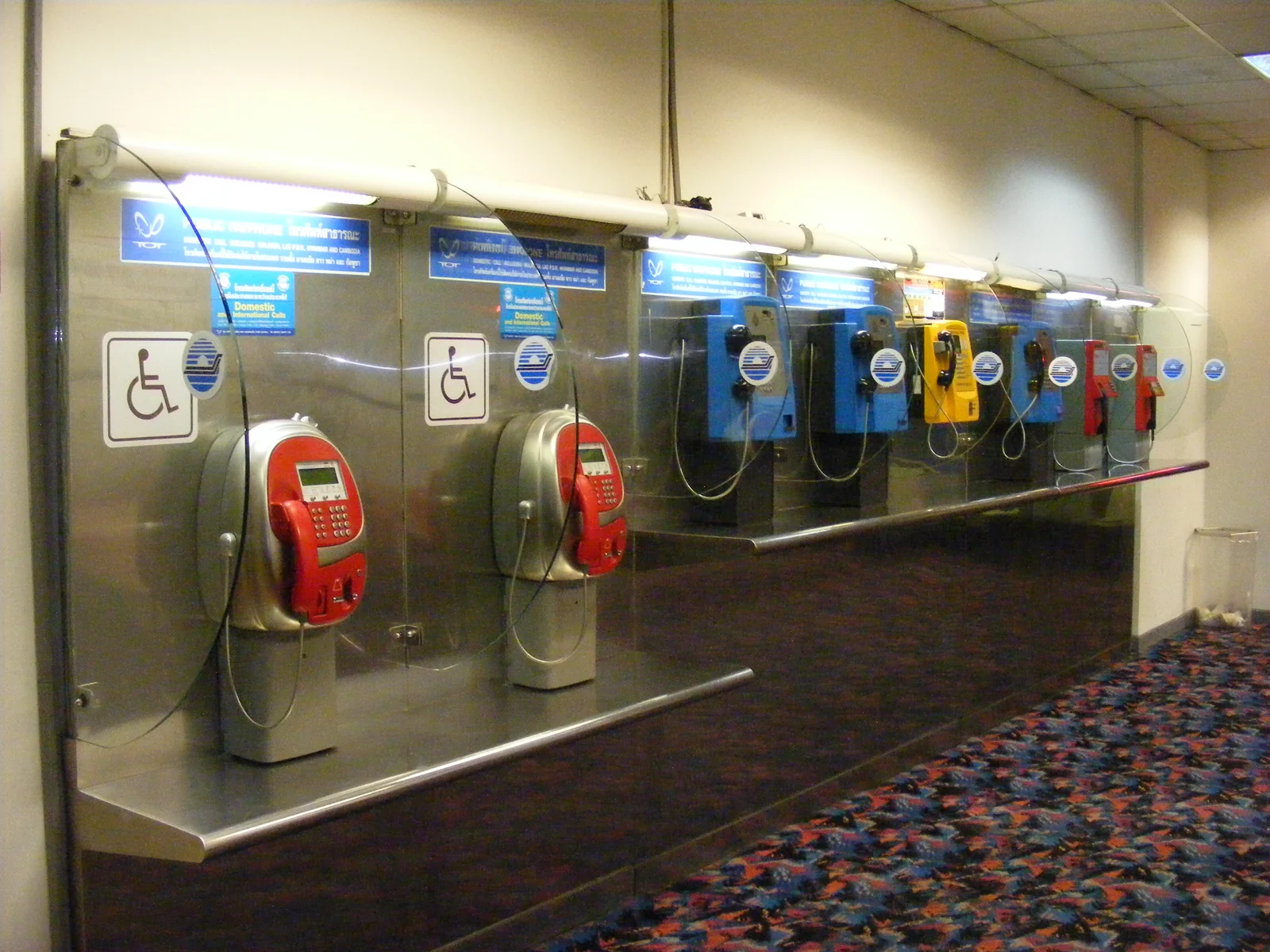 Photographer: User:Mattes. Source: Wikimedia Commons. License: CC BY-SA 3.0.
If you fly low-cost (AirAsia, Thai Lion, Nok, Vietjet), you almost certainly land at DMK. If you fly full service (Thai Airways, Singapore Airlines, Cathay Pacific, Emirates, ANA, JAL), you land at BKK. The exceptions are minor and route-specific.
For travelers connecting BKK → domestic onward (e.g. arrival from Tokyo continuing to Phuket), the same-terminal Thai Airways or Bangkok Airways flight wins. Cross-airport transfers (international BKK → domestic DMK) need 4+ hours buffer and a private airport taxi at THB 400 to 700.
Six airlines that move 90% of domestic Thailand traffic
Domestic Thailand flights cluster around six operators. Choice resolves on price, departure airport, and whether the destination has a Bangkok Airways monopoly route.
AirAsia (FD), the price leader
AirAsia operates the largest domestic Thailand network from DMK. Base fares run $25 to $50 booked 3 weeks ahead.
Last-minute fares climb to $60 to $90 one way under 7 days.
Cabin baggage is 7 kg in the base fare. Checked baggage adds $8 to $15.
AirAsia operates Bangkok to every major Thai airport including Krabi, Phuket, Chiang Mai, Hat Yai, Udon Thani, and Surat Thani. Does NOT fly into Koh Samui. Compare current AirAsia fares for DMK departures.
Thai Lion Air (SL), the fastest-growing low-cost
Thai Lion operates from DMK with a focus on domestic + regional. Base fares match AirAsia closely. Slightly larger 737 fleet means more capacity on popular routes. Less aggressive on ancillary fees. Same USM exclusion as AirAsia.
Nok Air (DD), the regional specialist
Nok operates mixed ATR turboprop + 737 fleet from DMK. Stronger on regional secondary airports (Nakhon Phanom, Buri Ram, Phitsanulok) that AirAsia and Lion ignore. Domestic fares similar to AirAsia. ATR routes feel like puddle jumpers. The 737 routes are full jet experience.
Thai Vietjet Air (VZ), the newer low-cost option
Thai Vietjet operates from both BKK and DMK, the only low-cost with split airport presence. Useful for travelers who need BKK departure for onward intercontinental connection. Base fares match the DMK pack.
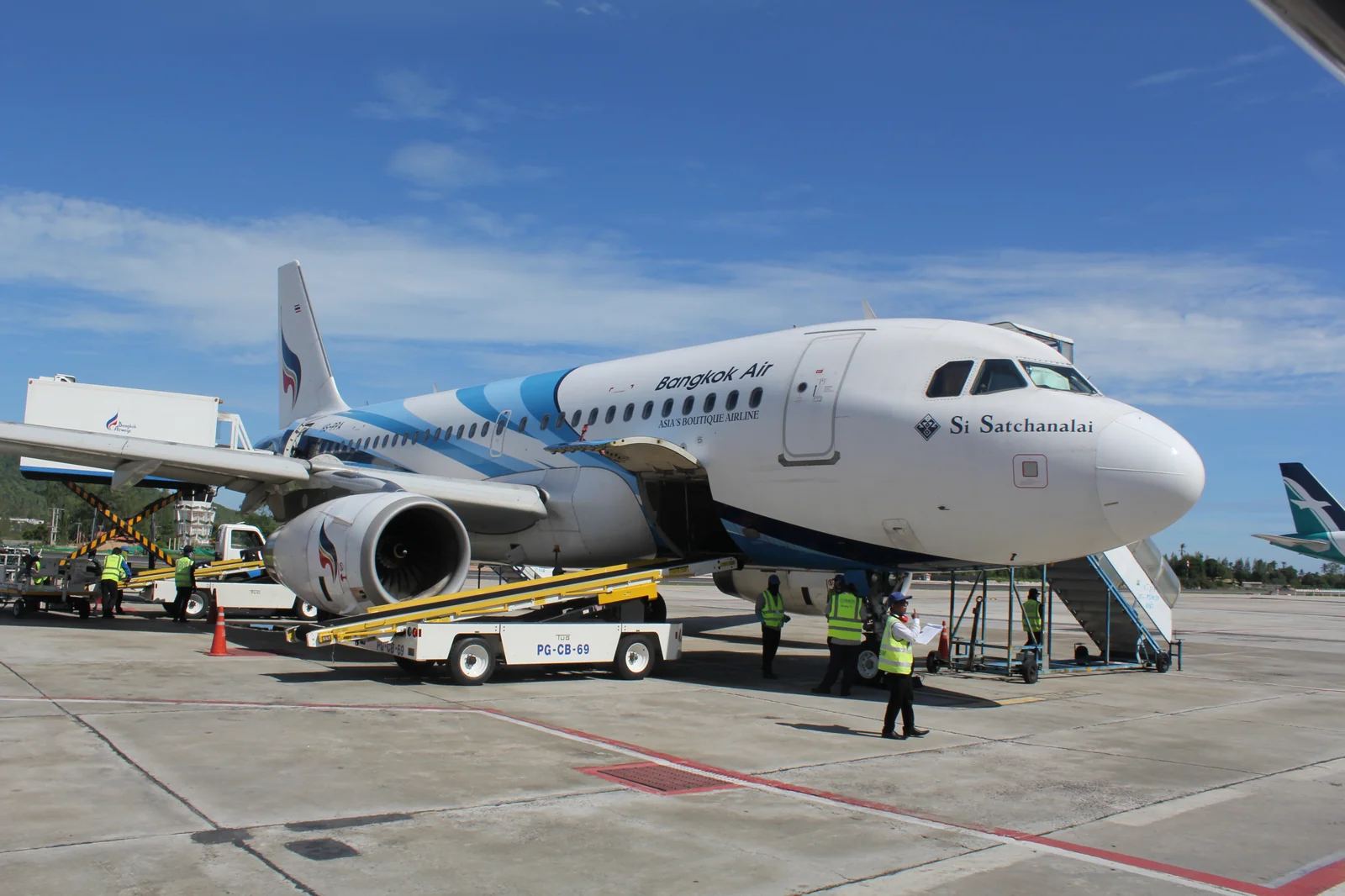 Photographer: D.G. Bouma. Source: Wikimedia Commons. License: CC BY-SA 4.0.
Bangkok Airways (PG), the boutique full service carrier
Bangkok Airways operates from BKK. Premium positioning with free lounge access for every passenger (not just business class) and complimentary snacks. Owns USM airport on Koh Samui, which gives them near-monopoly on Bangkok-Samui routes. Fares run $80 to $200 baseline, with no low-cost alternative available because USM denies AirAsia and Lion landing rights.
Thai Airways (TG), the legacy full service carrier
Thai Airways operates from BKK with the broadest domestic network including USM (small allocation), Phuket, Chiang Mai, and Krabi. Premium fares 40-60% above the low-cost band. Free meals and 30 kg baggage included. Best for travelers connecting from international Thai Airways arrivals (same-terminal transfer).
The Koh Samui monopoly route and how to work around it
Bangkok Airways owns Samui International Airport (USM). They control landing rights and refuse AirAsia, Thai Lion, and Nok Air access. The result on the Bangkok to Samui direct flight is $80 to $200 one way.
Compare that against $25 to $50 for AirAsia routes to other islands, and the monopoly tax becomes clear.
Three ways around the Samui monopoly tax:
- Fly to Surat Thani (URT) on AirAsia or Lion for $25 to $50, then ferry across to Samui for $5 to $20. Total trip 4 to 5 hours including transfer to Donsak Pier. See our Surat Thani to Samui ferry guide for operator details.
- Fly to Krabi (KBV) on AirAsia for $25 to $50, then bus + ferry via Donsak (longer but cheaper). See Bangkok to Koh Samui bus + ferry combo.
- Pay the Bangkok Airways tariff for the direct 1h 20min flight. Worth it if your time is worth more than $40 to $80.
Full guide: Bangkok to Koh Samui flights covers the monopoly economics in detail.
Domestic route guides on this site
Bangkok to major Thai destinations
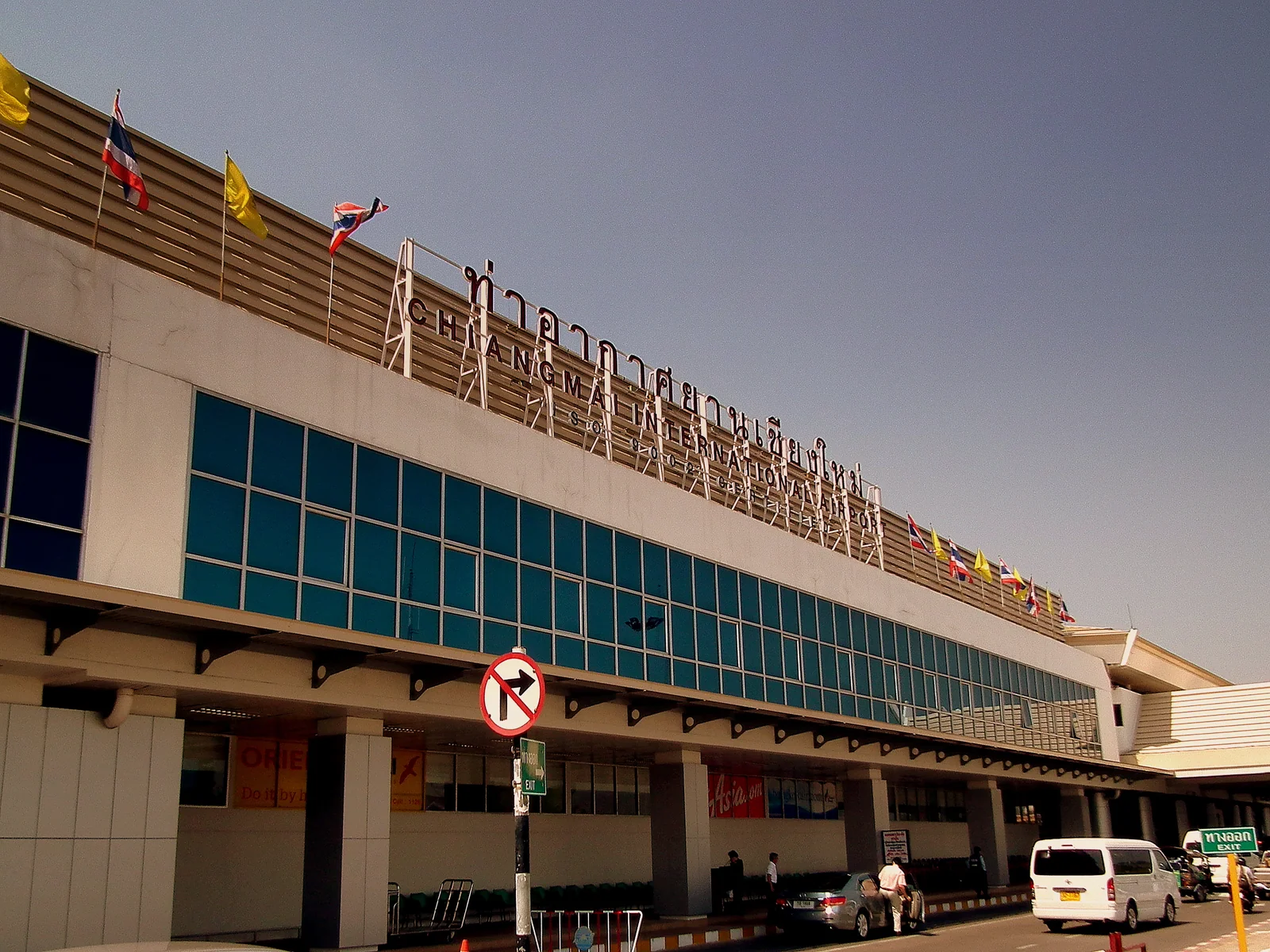 Photographer: calflier001. Source: Wikimedia Commons. License: CC BY-SA 2.0.
International arrivals into Bangkok and airline reality per region
Bangkok is one of Asia’s largest aviation hubs. Inbound flights to BKK and DMK arrive from every major Asian city plus Europe, North America, and Middle East. Pricing patterns vary by route.
- Hong Kong to BKK: Cathay Pacific (premium), HK Express (low-cost), Thai Airways. 3h flight. See Hong Kong to Bangkok guide.
- Singapore to BKK: Singapore Airlines, Scoot, AirAsia DMK, Thai Airways. 2h 30min flight. See Singapore to Bangkok guide.
- Kuala Lumpur to BKK: AirAsia (DMK), Malaysia Airlines, Thai Airways. 2h 15min. See KL to Bangkok guide.
- Tokyo to BKK: JAL, ANA, ZipAir, Thai Airways. 7h direct. See Tokyo to Bangkok guide.
Season pricing windows and the booking lead-time math
Thailand domestic and international flight pricing moves on three signals: lead time, season, and route-specific demand spikes.
Lead-time advance, the biggest lever
Domestic Bangkok to island routes booked 3 to 4 weeks ahead cost $25 to $50.
Booking under 7 days pushes the same flight to $60 to $120 one way, a 2x markup for procrastination.
The break-even is 14 days. Under that, prices climb steeply each day.
The advance-booking discount is most aggressive on AirAsia (50-60% off walk-up). Bangkok Airways and Thai Airways move 20-30% on lead time, less elastic because business travelers fill the late inventory.
Season pricing, the Songkran and Chinese New Year spikes
Two periods see flight fares double or triple year over year:
- Songkran (April 13-15): All domestic flights surge 100-200%. Book by February for normal fares.
- Chinese New Year (late Jan / early Feb): Inbound from China, Hong Kong, Singapore, Malaysia surge 50-100%. Domestic island routes also tighten.
- Christmas / NYE (Dec 23 – Jan 3): All routes surge 30-60%. International from Europe and North America hits 2-3x normal.
For travelers with flexible dates, shifting 3-5 days outside these windows saves 30-50% on the same route.
Route-specific demand patterns
Some routes have predictable demand spikes outside the obvious holidays. Full Moon Party week (monthly Saturday) inflates Bangkok to Koh Samui (USM) and Surat Thani (URT) by 20-40%. Songkran weekend in Chiang Mai pushes BKK to CNX fares to peak even before April 13.
Airport transfer math per arrival point
Flight time is half the journey. Airport transfer to your hotel is the other half. Budget these realistically.
- BKK Suvarnabhumi to central Bangkok: Airport Rail Link 26 to 45 min$0 45. Taxi 45 to 90 min$0 400 to 700 (depends on traffic and tolls).
- DMK Don Mueang to central Bangkok: A1 bus to Mo Chit BTS 45 min$0 30. Taxi 30 to 60 min$0 300 to 500.
- HKT Phuket to Patong Beach: Shuttle bus 60 min$0 200. Taxi 45 min$0 600 to 900.
- CNX Chiang Mai to Old City: Taxi 20 min$0 200 to 300. Grab 20 min$0 150 to 250.
- USM Koh Samui to Chaweng: Taxi 20 min$0 400 to 600. No bus service.
- KBV Krabi to Ao Nang: Airport bus 45 min$0 150 to 200. Taxi 35 min$0 600 to 800.
The Bangkok airport transfers are the most variable. BKK during peak traffic (5-8pm weekdays) can take 90+ minutes by taxi against 26 minutes by Airport Rail Link. The rail link is often the fastest option even for travelers with luggage.
Best booking platforms and the AirAsia direct trade
Aggregator search engines catch all major Thai airlines except some Bangkok Airways inventory. For domestic Thai routes the aggregators usually match the airline’s direct booking site within $2 to $5.
Two exceptions where direct beats aggregator:
- AirAsia flash sales announced via email and app. Sale fares are sometimes 30-50% below aggregator price for the same flight.
- Bangkok Airways FlyerBonus members get 5-10% off direct bookings for flights to USM and rare destinations.
For most travelers, the aggregator route is faster (single search across all airlines) and the savings on direct booking are not worth the comparison time. Sign up for AirAsia notifications if you book Thailand routes frequently.
For real-time prices across all airlines on any specific route, use the search box at the top of this page or check the dedicated route guide for the journey you need.
Combined flight + ferry routes to Phi Phi and Koh Lanta
Some destinations have no airport. Koh Phi Phi, Koh Lanta, Koh Yao Noi, and Koh Lipe all require a flight + ferry combo. The flight leg lands at Phuket (HKT) or Krabi (KBV), then a ferry takes 30 minutes to 2 hours to the island.
Full multi-modal guides:
- Bangkok to Koh Phi Phi (flight + ferry combined)
- Bangkok to Krabi (flight, bus, train + bus options)
- Bangkok to Koh Samui (bus + ferry alternative to the monopoly flight)
For the onward ferry leg from Phuket or Krabi to any Andaman island, see our complete Thailand ferry guide.
See also our Chiang Rai transport guide.
Frequently asked questions about flights in Thailand
Which airline has the most domestic flights in Thailand?
Why is Bangkok to Koh Samui so expensive?
BKK or DMK, which Bangkok airport should I fly to?
When should I book Thailand flights?
Is it cheaper to fly direct or with a connection in Thailand?
How early should I arrive at the airport in Thailand?
Are there flight + hotel package deals to Thailand?
Can I bring duty-free liquor on a domestic Thailand flight?
International route guides to Bangkok
International arrivals into BKK
For onward ground transport from Bangkok or any major airport, see our Thailand ferry guide. For 3 day itineraries built around these flight routes, see our Bangkok, Chiang Mai, Phuket, and Koh Samui itineraries.